Showing posts with label Apparel Industry. Show all posts

Wednesday, April 3, 2019

StitchWorld Editorial Issue March 2019

Already so many garment manufacturing technology fairs happen in India, but the focus is still not realistic India is a mega country with diverse needs and every state is as big as Bangladesh if not bigger, so why question the number of garment manufacturing technology fairs happening in India…


Looking at it from another perspective, each Indian state has so many garment manufacturing hubs that every one of them deserves a separate fair… consider Meerut, Panipat, Jaipur townships in North of India that are still unrepresented at such fairs, and on similar lines, there are many townships in South and East of India which require a technology fair to bring the local industry up to date on latest hardware and software technologies.

The understanding is that these townships comprise smaller players whose needs are also met by very basic technologies, and at most through automation at basic level.

But the factors that are still ignored at these technology fairs are the technologies of the future and the knowledge forum, which start with Industry 4.0, moving on to AI, Data Analytics, VR, additive technology to robotics… a missing platform for understanding how these new systems/ technologies are going to impact the way the industry will work in the future.

Though technologies and discussion forums need not be part of every technology fair since only the big and organised companies would be keen to take cognizance of the newer set of systems and processes at present; for them, having one big technology fair which showcases a route map for the future in any one place within India would be very much reachable.

If today, we do not start updating ourselves on such solutions, in no time, we will find that the industry is left with only small producers that are largely unorganised and unable to cater to the demands of the growing retail in India… Hence, leaving the space empty for import of garments from global manufacturers that are hungry for work and are ready to invest time, energy and resources to meet the needs of an evolving Indian retail market

We are very clear on the future directions and soon you will find StitchWorld fulfilling the role of guiding the industry to address the future… a future which is sustainable and growth-oriented!

Monday, February 25, 2019

StitchWorld Editorial Issue February 2019

ASW is launched to give impetus to our journey as industry’s knowledge partner

Did you notice the change from the usual routine... We have for the first-time ever in the history of the magazine put on the front cover our sourcing show – Apparel Sourcing Week 2019. This highlights our thrust as a group, which understands the apparel industry and its intricate details comprehensively to give qualitative, industry-focused shows to India...
From our years of interaction and involvement with the global apparel and retail industry, we are well aware that it’s not just about manufacturing at a certain price, offering good quality or timely delivery but also about the marketing and product that make the merchandise sell and become the preferred choice for buyers... Apparel Sourcing Week is a boutique show that will provide a platform for such products.

We aim to fill in the requisite gaps and become the much needed bridge to bring Asian manufacturing under one roof for Asian markets along with the traditional markets, besides, allowing companies to interact and discuss business in an atmosphere that is charged and engaging.

No, we have not lost our focus to be the knowledge partner to the industry! In fact the focus is now even stronger and ASW is the first in the series of our planned shows. You can see everything related to ASW at www.apparelsourcingweek.com

With time, you will see many more shows coming up which will be niche and focused and targeted to specific group of people within the industry,based on the inherent understanding and needs of the segment. And technology can never be behind when talking of industry’s directions. In this issue, Team StitchWorld takes a closer look at today’s trend of how apparel businesses are working and being driven by technology trends like Artificial Intelligence, IoT, Beacon technology and a lot more.

Significantly, retailers have been making substantial investment in these technologies to be able to provide a seamless experience to their customers and manage business like never before. The first part of the article –‘Technology trends driving seamless retail’ – will take its readers through 15 retail technologies available in the market that are driving the current retail trend. The second part of the series covering the next set of 15 more such technologies will be included in the upcoming issue of StitchWorld.

The current issue also captures details on the recently concluded technology fairs – DTG and Garmentech – held in Dhaka and the interesting technologies that were there on display. The momentum towards technology in Bangladesh is indeed noteworthy and an inspiration for all manufacturing nations, including India.

Monday, November 26, 2018

StitchWorld Editorial Issue November 2018

China leads the way to ‘intelligent factories’

If India is thinking to ‘catch up’ with China in the near or distant future as a manufacturing destination… I very much doubt if that is possible!

While we are still caught up in generating employment at the grass-roots, Chinese manufacturers, with the pro-active support of the Government, are focusing on ‘intelligent sewing’ and ‘smart manufacturing’ concepts that are way beyond what Indians are looking at.


We all know that the most advanced machines and equipment from practically any industry are already being made in China and more interestingly, even in those jobs that require ‘hands’, China is thinking far ahead of other countries…

I can speak from my experience in the apparel industry… today not just the garment manufacturers but also the sewing machine manufacturers too are opting for automated manufacturing concepts and even robotic systems.

Though there are 800 sewing machine factories (it was around 2300, 10 years back) in China today, the movement is towards consolidation to bring the numbers lower but with better technology and higher precision, so as to control the entire world’s sewing needs.

The process has already started with identification and support to two major companies from China, capturing the best and most established European sewing machine manufacturers… bringing them into their fold. I am almost sure that in the next five years, the Japanese will also sell out to the enterprising Chinese companies and leave the garment machine manufacturing space, entirely to China.

The next phase of eliminating ‘hands’ has also begun, majorly to address the increase in wages that impacts competitiveness, by funding the ‘smart’ movement in earnest. The movement is not just about digitising the industry, but also about cutting the unnecessary cost and creating systematic changes… in other words, building ‘intelligent factories’ of the future.

The same was evident during my team’s visit to the leading Chinese sewing technology provider Jack which had a number of innovations to show to its visitors inside its ‘first intelligent factory’ of China. The company is a trailblazer in sewing machine manufacturing and visiting the factory was an eyeopener.

Since 2016, Jack has been organising Annual Overseas Distributors’ Meet and StitchWorld has had the privilege to be a part in all the editions. The way Jack hosts its hundreds of guests who come from all across the world is really commendable and appreciable. It only goes on to reflect the thought process of the company, which is well sorted and systematic!

Though industries such as automobile and IT have already started building smart factories in order to digitalise their processes and to keep a watch on every incident in real time, it is only now that the apparel industry is sensing the need for such factories to combat the rising cost challenges and avoid miscellany of information which they face due to the traditional approach. In this issue, we have covered an article based on expert opinion from garment and steel industries to know the practicality of smart factory concept in the apparel manufacturing sector.

Thursday, July 12, 2018

Stitch World Editorial July Issue 2018

Saving cost is one of the biggest agendas for every garment exporter today… Every company is looking at how to reduce its running cost and save enough so that the bottom line is healthier.


While some companies are working within the factory to squeeze out an extra penny, others are exploring new destinations that are cost-effective. All said and done…, a solution has to be found!

When the ‘cost’ bug hit the industry many years ago, we saw factories being shifted from established hubs to interiors outside the city limits. While many Delhi based companies opened factories in Manesar, the fate of most of them is a sad story today…, only a few found success like Sarita Handa; others have either rented out the premises or are operating at below optimal levels.

The biggest reasons that exporters quote when questioned about the failure, is difficulty in getting trained manpower and the travelling woes of the middle management leading to fast turnarounds.

Similarly, other hubs too saw movement to the interiors… Laguna went to Kanakapura on the outskirts of Bangalore, while GO GO International travelled to Holenarsipur, Hassan, again on the outskirts. How fruitful these moves have been, is debatable and open to interpretation.

Armed with past experiences, companies are now therefore more keen to travel to Tier-2 cities, being backed by State Government support. Here, besides the initiatives being offered, which are quite attractive, there are facilities like airports, schools, hospitals, etc, which a company needs to set up a people-oriented industry like garments.

I have been saying for long that moving to outskirts is not a very viable option because the ecosystem for conducive business is not available. Rather the smaller cities like Ranchi, Bhubaneswar, Gandhinagar are much better options.

The number of investments that we are seeing in these cities from companies like Shahi, Matrix, Pearl, Orient Craft, Texport, Arvind, Madura Garments, Page Apparel, Kishore Exports, Shakti Wear, Meenakshi Ltd., JP Sports Apparel to name a few, is impressive. I am sure once these factories set the trend and prove successful, many more investments can be expected.

While in India, we are still struggling to save cost mostly from workers’ wages, the West is looking at high technology to get manufacturing back without the pressure of wages!

Exhibitors at Texprocess Americas this year echoed the future of apparel industry with the theme ‘Digital Apparel Microfactory’: A manufacturing set-up where various different technologies are combined together to fill customers’ orders in quantities as low as one. It can be started in even a small room and has become the strength for manufacturers based in USA. This issue of StitchWorld highlights this trendsetting concept and how the companies are embracing it.

Exploring new product categories apart from apparel has always been StitchWorld’s interest. This time, our team visited HH Interior’s factory and explored the quality and manufacturing aspects of car seat covers. A must read…

Continuing with our Poll section, read interesting views from industry experts on the topic ‘Will mass manufacturing return to the USA?’

Friday, March 16, 2018

Stitch World Editorial Issue March 2018

Industry 4.0 is very much in the news and also a hot topic of discussion in magazines and seminars, the world over. We are also following the market trends and discussing the many facets of this topic in the pages of StitchWorld. In this issue too, we bring you insights into the latest discussion on agendas covered by experts sharing the multiple benefits that Industry 4.0 offers.


It is another matter if we would be using any of these concepts in apparel manufacturing and in the context of the Third World countries, in the near future. But then, apparel is not the only industry using sewing technologies. It's being used in industries manufacturing products right from water rafts, parachutes, sails, airbags, tents to all other industries which are using technical textiles as a substitute for hard materials. Significantly, products being manufactured by these industries require high precision and speed and for which the price of the product is not so much of a constraint.

Understand that the concept 4.0 is presently at a very early stage of evolution. It will take few years for it to settle down with a definitive direction. SW is also transforming and growing with the evolution of this concept. That's what we as editors of StitchWorld do, keep a close watch on the evolving trends.

Many years ago, we caught the concept of ‘Lean’ in the apparel manufacturing industry at a very early stage and covered it intensively from all dimensions in our pages. Today, we are bringing out a book on 'Lean concept and its implementation in the apparel industry’ with case studies based on the articles published in SW from time to time.

On similar lines, you would be seeing many books and reports in the next couple of months… This is the fruit of our efforts to compile concepts, formulated and discussed over time and at length, in one comprehensive format as an easy reckoner for practitioners and students of the industry.

The current issue of SW brings to you some interesting technologies that drew attention at the recently concluded GTE. In addition, you will also get an insight into Utah Fashions Ltd., a Bangladesh based apparel exporter that has been carving a benchmark in lean with the practices it follows. Following the growing importance of fire safety, Team SW also brings out the vulnerabilities in factories which lead to fire accidents.

Tuesday, July 4, 2017

Stitch World Editorial Issue July 2017

A change is inevitable now. All because of the few incidents that have happened or are going to happen…

Last year was the most uneventful year for exports in a long time…, maybe it was a year in brooding. The export growth figures were down and the domestic market was depressed due to demonetization and fear of GST (some are comparing it to the Y2K virus, which created such a hype at the turn of the century but fizzled out to nothing).

I believe that fear is bigger than reality…, yet there are genuine concerns, mainly because of the lack of clarity and implementation hurdles. In the meanwhile, the textile industry is divided on how the reforms would impact businesses along the supply chain, though there is a conviction that it would have a positive influence on the competitiveness in the long run.

The recently concluded Textiles India 2017 extravaganza was a breeding spot for discussions and the four major concerns with regard to GST that emerged are: Accumulation of credit at every level of the chain; Imported fabric to be cheaper than domestic fabric; 18 per cent service tax on apparel job work to make outsourcing unviable; and 18 per cent GST on MMF and Yarn serving as a severe blow to the synthetic sector.

Though the Government has assured a review and revision after three months, the industry is on the back foot. While demonetization brought in lack of funds to source raw materials and pay wages, GST has brought uncertainty, thereby further crippling the system.

As if this was not enough, the Delhi Government has increased minimum wages by 50%... I am not even sure if the industry can survive after such a huge blow… Where are the margins to absorb this increase?

Though the honourable court has reserved the decision till 11th September, I doubt if the court will eventually ‘stay’ the move.

With all this happening, the only way to survive is to move to places like Jharkhand, Odisha, Telangana and other states where the Government is pro-active in building infrastructure and is offering incentives to the industry to come in, including a rebate on wages. Jharkhand already has three bigwigs setting up units there – Orient Craft, Shahi Exports and Matrix Clothing…, and I am sure others will follow suit soon.

I sincerely believe that this is the best and the only way for the industry to grow now!

In the meanwhile, things are getting tough on the retail front also with stores closure and frequently changing consumer demands putting pressure on retailers to be faster than their competitors in placing their products on the shelves. Ram Sareen, Founder, Tukatech shares with our readers how the long sheets of tech packs cannot keep pace with the evolving fashion industry. It is the digital platform that should be the new communication language between designers and technical team. Longer the retailers rely on outdated means, sooner they will be out of business.

Another trend which is taking fashion to a next level is ‘athleisure’. Driven by millennials’ fitness-conscious behaviour, athleisure is the new take of the town. Fad or classic, athleisure is not going to lose its charm in the coming years. Two of Indian sportswear manufacturers, Paragon Apparels and Creative Clothex, have launched their own athleisure brands in the market to tap the potential market in India

Monday, March 6, 2017

Stitch World Editorial Issue March 2017

The buzzword today is Industry 4.0… Every international forum, seminar and trade fair is discussing and deliberating on disruptive innovations such as IoT, M2M, Vision Systems Integrated Sewing, 3D Sewing, and Robotics. The topics are relevant today in the wake of efforts by Western countries – the US and Europe - to bring back the sewing industry… I think the industry is on the cusp of evolution since the talk on such subjects is overwhelming.

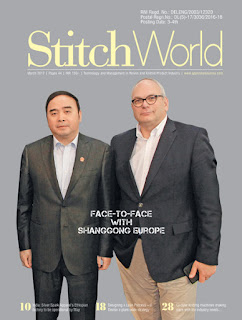
 Stitch World Issue March
In a new series starting this issue, we will bring to our pages the leaders driving the innovation in the industry. The first part of the series is an excerpt of the discussions I had during a recent tête-à-tête with the management team of the ShangGong Group, which has acquired some really big names in European technology, including Duerkopp Adler.

During my regular visits to Bangladesh, I have noticed that the country is fast moving towards high-end technology, much more than compared to India, though India is the largest importer of sewing machines today. While India is importing a lot of basic machines, established brands are very happy working with Bangladesh for their automated machines.

It seems that the garment export industry in India has reached a plateau and now the domestic market is at the stage which was occupied by export market in the early 80s, providing good opportunities for technology providers to work in large numbers, but in basic machines. Perhaps that is why we see large number of domestic players at technology events in India these days.

I hope it is not the end of growth for the garment export industry… There has to be a lot more juice left in the industry than generally perceived. The drive to skill people in huge numbers for the sewing industry and the overtly active State Governments inviting industry to set-up units for exports with lucrative incentives, will surely not let the export industry die out.

This is one editorial in which I have not offered any solution, but only raised my concerns… If you think otherwise, please send me your views.
In the meanwhile, we bring to our readers another edition of StitchWorld which is a gamut of technology and management tools. INH Quality Management by Groz-Beckert facilitates an interconnected process for the entire history of a needle from its entry into the company through the documentation of needle breakage to the point at which it leaves the factory in a recyclable condition.

Our content remains incomplete without the experts sharing their valuable strategies and experiences. Piyush R Vyas and Anand Deshpande are there in the issue to share on how to reap the advantages from implementation of lean, not only benefiting the factory, but Indian apparel industry as a whole.