Showing posts with label Sewing Industry. Show all posts

Thursday, June 27, 2019

StitchWorld Editorial Issue June 2019

The stagnation seen in apparel imports by both the US and EU this year is severely impacting the manufacturers in south-east Asian countries. Players in Bangladesh, Vietnam, Sri Lanka and to some extent India are now earnestly vying for the space being vacated by China in apparel manufacturing; this seems to be the only way to grow.


Interestingly, while manufacturing in India is now increasingly being safeguarded by the growing local market fuelled by rising consumption by both expected and unexpected markets, other countries have very little to fall back on.

Even as south-east Asian manufacturers try to find new markets and better penetration in older markets, they are hit by the growing preference for onshoring and nearshoring, both of which are faraway dreams for manufacturers in this region… The advantage is definitely going to places like Turkey, East Europe and Mexico.

The reflections of this trend were strongly visible at the recently concluded Texprocess in Germany, a must-visit fair for the sewing industry. The shift in technology is noticeably on digital interventions for operational flexibility and ease of operations.

Secondly, amidst all the focus centering around automation, robotics and 3D rendering, concepts like digital factories, micro-factories, on-demand manufacturing processes, additive technology and whole-garmenting etc.,are bound to shift the business back to the West, whether in the country of retail or near to it.

The interest that lies in these concepts is obvious, and at Texprocess, the micro-factory theme stole the show with at least five factories on display. Each demonstrated how companies can adopt this concept in order to transform their factories or retail stores, and embrace on-demand manufacturing.

The event also became a launching pad for new technologies in sewing with giants such as Vibemac, Vetron and Duerkopp Adler displaying their latest innovations, all for customers’ ease of operations.

Taking a drive towards new directions, this issue of StitchWorld looks at the cloud based solutions that are revolutionising the merchandising process to save ample amount of resources, money and time, resulting in higher efficiency and shorter lead time. The article highlights how global leaders like Tukatech, Gerber Technology, Lectra and Simbus are transforming the fashion industry with this innovative cloud based model.

Another interesting article for our readers this time is on sports bra, a challenging garment that demands support and shape of breasts in dynamic conditions (especially bouncing). The team analyses the Maaree Smart Sports Bra, delving deep into the innovative pattern of engineering and construction that goes behind it.

Monday, October 15, 2018

StitchWorld Editorial Issue October 2018

Industry’s mantra: An amalgamation of technological upgradation and constructive HR methodology for best results.
The latest trend in the industry is to hold and even attend seminars and workshops on the concept of Industry 4.0 which includes digitisation, augmented reality, artificial intelligence, machine-to machine learning and 3D printing.

Gone are the days when technology for better and efficient production was the focus of attention. It seems that the incremental changes towards automation in sewing are taken as not so critical anymore, at least not critical enough to hold or attend workshops. And this can be substantiated by the fact that many of the smaller sewing machine manufacturers are selling out to bigger companies.

This is certainly not going to help the garment manufacturing industry in the short or even in the long term. However small they may be, upgradation in technology is significant to keep pace with the needs of today and should be discussed and appreciated.

 It is therefore important for the garment manufacturers to take a prudent approach and keep abreast of the latest hardware and upgraded technologies, as also be concurrently aware about the technologies of the future.

This balanced approach to learning will be helpful to grow in the present and be prepared for the future!

The second most popular topic for industry today is now Human Resource Development, which is nothing more than sharing newer methods or jargons to motivate employees/operators, considering the fact that the industry lacks formal, pragmatic contemporary HR systems and interventions.

For attaining lasting success, organisations need to embrace the key role of human resource as a necessary catalyst to enhance the entire production system by making it smoother and swifter than before.

Our current issue entails an exclusive coverage on the emerging ‘on-demand’ apparel manufacturing concept in the USA along with its diverse pros and cons being discussed by the US-based apparel industry experts.

Monday, March 6, 2017

Stitch World Editorial Issue March 2017

The buzzword today is Industry 4.0… Every international forum, seminar and trade fair is discussing and deliberating on disruptive innovations such as IoT, M2M, Vision Systems Integrated Sewing, 3D Sewing, and Robotics. The topics are relevant today in the wake of efforts by Western countries – the US and Europe - to bring back the sewing industry… I think the industry is on the cusp of evolution since the talk on such subjects is overwhelming.

 Stitch World Issue March
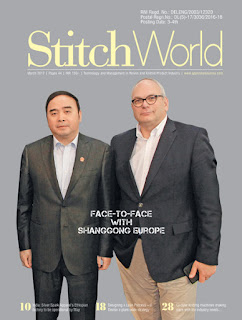
In a new series starting this issue, we will bring to our pages the leaders driving the innovation in the industry. The first part of the series is an excerpt of the discussions I had during a recent tête-à-tête with the management team of the ShangGong Group, which has acquired some really big names in European technology, including Duerkopp Adler.

During my regular visits to Bangladesh, I have noticed that the country is fast moving towards high-end technology, much more than compared to India, though India is the largest importer of sewing machines today. While India is importing a lot of basic machines, established brands are very happy working with Bangladesh for their automated machines.

It seems that the garment export industry in India has reached a plateau and now the domestic market is at the stage which was occupied by export market in the early 80s, providing good opportunities for technology providers to work in large numbers, but in basic machines. Perhaps that is why we see large number of domestic players at technology events in India these days.

I hope it is not the end of growth for the garment export industry… There has to be a lot more juice left in the industry than generally perceived. The drive to skill people in huge numbers for the sewing industry and the overtly active State Governments inviting industry to set-up units for exports with lucrative incentives, will surely not let the export industry die out.

This is one editorial in which I have not offered any solution, but only raised my concerns… If you think otherwise, please send me your views.
In the meanwhile, we bring to our readers another edition of StitchWorld which is a gamut of technology and management tools. INH Quality Management by Groz-Beckert facilitates an interconnected process for the entire history of a needle from its entry into the company through the documentation of needle breakage to the point at which it leaves the factory in a recyclable condition.

Our content remains incomplete without the experts sharing their valuable strategies and experiences. Piyush R Vyas and Anand Deshpande are there in the issue to share on how to reap the advantages from implementation of lean, not only benefiting the factory, but Indian apparel industry as a whole.

Friday, January 6, 2017

Stitch World Editorial Issue January 2017

StitchWorld is in its 14th year, and has evolved tremendously in its content and reach. We have graduated from topics like operator and supervisor training to concepts like IoT, M2M and automation, moving towards Robotics and the era of 3D printing and 3D pattern making. Yet, the focus of the magazine has not changed at all - productivity, on-time delivery and quality - still remain at the core; how to achieve these goals are evolving, resulting in new concepts and management tools.
Today, managing a factory is a very complex game; it is no longer about just building a state-of-the-art factory. How the factory is managed, and what are the external influences and challenges of profitability are critical elements that can make or break even the best of factories… Through the year, my editorials have reflected these challenges…, emerging from factors both within and outside the factory.

It all sounds very nice, but the industry is taking a cautious stand… They know that Governments don’t really understand the nuances of the industry, and just by giving incentives to set-up a unit is not going to help the cause. I have pointed out many
times that the issue is inter-related to many concerns… In my editorial in February, I had said, “The three areas that need attention are ‘Clean India’, ‘Healthy India’ and ‘Corruption-free India’. If these three areas are taken care of, all other requirements for sustainable growth of manufacturing will follow automatically.”

Another interesting point that evolved over the year and strongly advocated by the stalwarts of the technology industry is that automation alone is not the answer to labour issues… They emphasize on the need to balance automation with motivation. I fully endorse this view and we are almost ending from where we started - operator training; only the focus is not so much on training but motivation!

I had pointed out in my September editorial that too much automation is not a solution, it has to be selective automation on those operations where replacing the labour makes sense. After all it is about replacing labour wages that cost rupees per month as against western countries where the equation is in dollars per day.

External influences like terrorism, Brexit, US elections have all been contemplated on, and 2017 will see how these events of the past year will push business interest. New innovations, technology service outsourcing, re-shoring and new global manufacturing destinations like Ethiopia and Myanmar have all found place in various editorial musings… But what I would like to say fresh is that the time has come to reassess the scope of StitchWorld - sewing industry is now too big to be limited by the literal context.

This year we propose to re-orient focus within the gamut of garment manufacturing and management. The new focus areas besides the core subjects of production technology and production/product management will be on: Technology 4.0 that will talk about future technologies; Information Technology - a rundown on latest offering from the segment; Global Sourcing - acknowledging that manufacturing in one country is a culmination of sourcing from various destinations; Sustainability - the future no doubt; HR Management - a step upward from pure labour issues; Value Addition - creating differentiation for companies and countries; and finally Knitting Technology - a reality check, recognizing that garmenting is both
about woven and knitted products.