Showing posts with label Sewing Machines. Show all posts

Monday, November 26, 2018

StitchWorld Editorial Issue November 2018

China leads the way to ‘intelligent factories’

If India is thinking to ‘catch up’ with China in the near or distant future as a manufacturing destination… I very much doubt if that is possible!

While we are still caught up in generating employment at the grass-roots, Chinese manufacturers, with the pro-active support of the Government, are focusing on ‘intelligent sewing’ and ‘smart manufacturing’ concepts that are way beyond what Indians are looking at.


We all know that the most advanced machines and equipment from practically any industry are already being made in China and more interestingly, even in those jobs that require ‘hands’, China is thinking far ahead of other countries…

I can speak from my experience in the apparel industry… today not just the garment manufacturers but also the sewing machine manufacturers too are opting for automated manufacturing concepts and even robotic systems.

Though there are 800 sewing machine factories (it was around 2300, 10 years back) in China today, the movement is towards consolidation to bring the numbers lower but with better technology and higher precision, so as to control the entire world’s sewing needs.

The process has already started with identification and support to two major companies from China, capturing the best and most established European sewing machine manufacturers… bringing them into their fold. I am almost sure that in the next five years, the Japanese will also sell out to the enterprising Chinese companies and leave the garment machine manufacturing space, entirely to China.

The next phase of eliminating ‘hands’ has also begun, majorly to address the increase in wages that impacts competitiveness, by funding the ‘smart’ movement in earnest. The movement is not just about digitising the industry, but also about cutting the unnecessary cost and creating systematic changes… in other words, building ‘intelligent factories’ of the future.

The same was evident during my team’s visit to the leading Chinese sewing technology provider Jack which had a number of innovations to show to its visitors inside its ‘first intelligent factory’ of China. The company is a trailblazer in sewing machine manufacturing and visiting the factory was an eyeopener.

Since 2016, Jack has been organising Annual Overseas Distributors’ Meet and StitchWorld has had the privilege to be a part in all the editions. The way Jack hosts its hundreds of guests who come from all across the world is really commendable and appreciable. It only goes on to reflect the thought process of the company, which is well sorted and systematic!

Though industries such as automobile and IT have already started building smart factories in order to digitalise their processes and to keep a watch on every incident in real time, it is only now that the apparel industry is sensing the need for such factories to combat the rising cost challenges and avoid miscellany of information which they face due to the traditional approach. In this issue, we have covered an article based on expert opinion from garment and steel industries to know the practicality of smart factory concept in the apparel manufacturing sector.

Monday, October 15, 2018

StitchWorld Editorial Issue October 2018

Industry’s mantra: An amalgamation of technological upgradation and constructive HR methodology for best results.
The latest trend in the industry is to hold and even attend seminars and workshops on the concept of Industry 4.0 which includes digitisation, augmented reality, artificial intelligence, machine-to machine learning and 3D printing.

Gone are the days when technology for better and efficient production was the focus of attention. It seems that the incremental changes towards automation in sewing are taken as not so critical anymore, at least not critical enough to hold or attend workshops. And this can be substantiated by the fact that many of the smaller sewing machine manufacturers are selling out to bigger companies.

This is certainly not going to help the garment manufacturing industry in the short or even in the long term. However small they may be, upgradation in technology is significant to keep pace with the needs of today and should be discussed and appreciated.

 It is therefore important for the garment manufacturers to take a prudent approach and keep abreast of the latest hardware and upgraded technologies, as also be concurrently aware about the technologies of the future.

This balanced approach to learning will be helpful to grow in the present and be prepared for the future!

The second most popular topic for industry today is now Human Resource Development, which is nothing more than sharing newer methods or jargons to motivate employees/operators, considering the fact that the industry lacks formal, pragmatic contemporary HR systems and interventions.

For attaining lasting success, organisations need to embrace the key role of human resource as a necessary catalyst to enhance the entire production system by making it smoother and swifter than before.

Our current issue entails an exclusive coverage on the emerging ‘on-demand’ apparel manufacturing concept in the USA along with its diverse pros and cons being discussed by the US-based apparel industry experts.

Tuesday, September 25, 2018

StitchWorld Editorial Issue September 2018

Positive, Domestic Market Growing

Last month was a very busy month for us, with the dates of both Gartex, New Delhi and GTE, Bangalore clashing. It created quite a chaos for some companies that would have liked to be at both the places, but overall, the fairs were successful.

Though the focus of the two fairs was different, the feedback from the industry was very similar. At Gartex, the emphasis was on digital technology, embroidery and denim, while GTE was mostly about sewing technology. And, both fairs saw good visitation along with a significant presence of the domestic market which was noteworthy.


The fairs revealed that the domestic market is thriving with opportunities and not only have the bigger manufacturers upgraded themselves, but even smaller units are looking for growth avenues.
It was enlightening to talk to these small, often considered marginal players, to know about their keenness to explore new technologies, specially in the value addition segment, which was indeed amazing. Many of them actually placed orders for digital printing technologies!

As for the exporters, they also came, but their attitude was more cautious and reserved. Enough has been said on the role or rather on the absence of a role, by the Government, particularly of the textile ministry supporting the industry in its time of need. The good thing that has come out of all this is that the industry has finally come to terms with the fact that they have to pave their own road rather than just waiting for things to happen.

It is obvious that the industry has evened out and only those who are ready to change will remain and prosper. Opportunities are floating, but grabbing them requires a strong mindset and a competitive manufacturing set-up. It was good to see a more practical industry, ready to take on the challenges.

A technical review of both fairs can be found in the following pages of Stitch World. Besides these reviews, some of the other interesting analyses include an ever-raging discussion on the performance of men vs. women at work. For any other industry, the views are very subjective, but on the shop floor, women sewing operators seem to have emerged as clear winners. Read on to find out what the industry thinks…

Check shirts are men’s favourite, be it casual style or formal… every male has a check shirt in his wardrobe. The beautiful, symmetrical checks take the maximum time in cutting department due to mitering requirements in different areas of the garment. While mitering or matching of checks (in different parts of the shirt) enhances the aesthetics of the shirt, some become a nightmare (the ones which are made symmetrical to create brand identity). Dr. Prabir Jana, Professor, NIFT, Delhi questions some of the critical parameters of shirt making in the article ‘Shirt Making: Technical Excellence or Design Nightmare’.

Another important topic touched upon in this issue is on the ease of PMTS solutions. While one requires a formal training to operate the time and motion study software, timeSSD breaks all such barriers with an interesting experiment conducted among NIFT students.

Tuesday, November 7, 2017

Stitch World Editorial Issue November 2017

CISMA – the technology fair that takes place in Shanghai, China – is not what it used to be. In the last two editions, it has changed its character from being a technology fair for basic machines to matching international standards of automation and moving towards industry 4.0 and showing signs of integrating robotics..., probably reflecting the signs of maturity in the Chinese garment manufacturing industry that is now demanding automation and moving towards robotics all because of the increase in wages and infrastructure cost...

Observing the shift, I also found that while some of the technology is being developed recently, some are decade old technologies making reappearance. All this is becoming possible today due to the increasing affordability of those technologies to cater to the demand for high productive machines.

Auto Bobbin Changer (ABC) – developed in 1995, but phased out from commercial machines due to exorbitant cost, is now making a reappearance; 3mm thread by UBT – developed in 1993, but phased out from commercial machines (probably cost of labour was cheaper to trim after sewing) is making a come back due to wage increase; Real time data from sewing machine – developed in 2003 by Efka has reappeared as cost of networking and data flow is becoming negligible. The CAM (computerized cutter), which came to India in 1997 (installed by Sewa International) with Rs. one crore investment, is still costing the same, but after two decades, the CAM now has multiple and better features… making it affordable.

In this editorial, I am just giving a glimpse of ‘affordable’ technology. Watch out for the next issue, wherein I will give my readers an ‘affordable article’ as food for thought!

In this issue, we have covered technologies displayed at CISMA and have also highlighted the ten top sewing features added to the machines in the recent past. Further, two garment exporters from Tirupur have been interviewed and their manufacturing best practices are highlighted. The common thread between the two is that both have imbibed the lean solution as the core driver for their growth.

Friday, October 6, 2017

Stitch World Editorial Issue October 2017

Two diverse developments in the garment arena are fascinating me today. The first being the talk about Industry 4.0 and the speed of the industry to adopt machines to impress the garment manufacturers.

However, many have an ambiguous understanding of the concept and are already positioning their technologies as Industry 4.0, ready to impress their customers. Their limit to get admiration can extend up to just putting a sensor to mark the machine temperature,which is communicated to the user via an app and qualifies for a company as an Industry 4.0 ready technology!

It is obvious that the garment manufacturers currently are unware about this emerging innovation since they accept every bit of computer-aided technology presented to them as Industry 4.0 ready, without question. But then, every concept takes time to develop and shape up to a level when both sides of the industry become well-versed and equipped to understand the thought in its totality and use it optimally.

The second development that I am watching very carefully is the upward movement of manufacturing in the USA, which is now US $ 13.6 billion of shipments annually, and which is growing further. Though most manufacturers in the US have small units with 25-60 machines, the growth is coming through big Chinese investments that are happening in garmenting, of late.

The latest is a Chinese company setting up a robotic plant in the US to take advantage of the ‘Trump Trust’ for local manufacturing. I am sure these kinds of initiatives would put a greater emphasis on the need to expedite Industry 4.0 equipped technology.

I will be visiting CISMA this month and it will be interesting to see how Chinese technology companies are geared up to imbibe Industry 4.0 in their technological processes. Earlier this year, the 4.0 revolution was the buzzword at Texprocess, Germany.

StitchWorld has always stayed ahead, bringing you all the newer perspectives and latest technologies, without losing touch with reality, because the major chunk of manufacturing still happens in the Third World (developing) economies, which require basic machines and few automats to make complete use of lower labour wages.

Our special issue covers a comprehensive preview of the technology variants that one can look forward to witness at CISMA from various technology manufacturers from around the globe.

Thursday, May 4, 2017

Stitch World Editorial Issue May 2017

Speed factory, store factory, micro-factory and cluster factory (a term coined by me) are some of the concepts conceived especially to reach out to the consumers faster… These very consumers are the ones who are also driving the price and the products they want.


The fallout is that so many of the big-box retailers and brands are either folding operations or stagnating in their growth, therefore necessitating new concepts to evolve with the help of IT innovations (collaborative designing and its communication), 3D printing, digital printing, dyeing, and also robotics, which in a simpler form means customized automation.

Some of the newer concepts slated to debut at Texprocess 2017 are digital processing, use of low-energy radial shockwaves to clean textile and cold ironing... In digital processing of performance textiles, functional chemicals are applied through inkjet technology; the low-energy radial shockwaves take lesser time, operate at low temperature and don’t harm textile much; and cold ironing technology simply reduces the energy consumption by 60 per cent.

These concepts may not be for many of you as manufacturers, as of now, but you can draw out a hint from the directions and take necessary steps which need to be there when the changes begin to shape up.

Continuing to present the current and future of the industry…, our section on Technology 4.0 discusses ‘Innovations in these disruptive times’. In this article, Frank Henderson, President, Henderson Sewing Machine along with Dr. Prabir Jana, Professor, National Institute of Fashion Technology (NIFT) Delhi, talk about interesting concepts in sewing automation, three-dimensional sewing, robotics, affordable automation, IoT and smart wearables. Also discussed is ‘3D printing of sewing machine parts’ – a concept developed by Dr. Jana and Dr. Deepak Panghal, who is also a Professor at NIFT Delhi.

However much we may dwell into the future and prepare for the same, it is also important to be in present and ensure that the factories are running productively. In our production technology segment, David Permenter, Educational Director, DCC Print Vision LCC details the Kaizen concept in screen printing in a three-part series. He emphasizes that ‘synergizing’ printing, manufacturing and leadership are the three pillars of screen printing.
Read the section to know more...

Also in focus are the growing number of Chinese sewing machines manufacturers invading the Indian market, and a preview of what to expect at the Texprocess in Frankfurt.

Friday, April 7, 2017

Stitch World Editorial Issue April 2017

May is going to be an interesting month for me as I will be attending Texprocess in Frankfurt, Germany…, something that I really look forward to.

Somebody, sheepishly asked me why visit Texprocess when such technology fairs take place in developing countries also…? My answer was simple: “Texprocess is the only international technology trade exhibition of our industry which is a ‘distinct depart’ from the basic technologies that one sees everywhere, at almost every fair happening in any part of the world!” It is not only the range of products that makes it impressive, but the advancements in each process which is a ‘value creation’, makes the fair a must-visit for those looking to understand< the future of the industry.


The Digital Textile Micro Factory, which is a live demonstration of apparel production chain to address the needs of small batches or even one-piece orders, is definitely something that the industry will find interesting at the fair.

Another special experience at the show will be the ‘Living in Space’, a part of Techtextil, which happens concurrently with Texprocess that will showcase a wide variety of applications for technical textiles in space travel together with the processes involved.

On a recent visit to India, Michael Jänecke, Director, Brand Management, Technical Textiles & Textile Processing, Messe Frankfurt Exhibition GmbH presented me with a beautiful pen drive in the shape of a space traveller wearing a space suit and also handed over space food, which travellers eat when in space… Nowhere else can I get such an experience… Only at Texprocess in combination with Techtextil we can even expect something so unique!

Going by the trend to think futuristic…, the next issue of StitchWorld will carry two articles of utmost importance. One is on Robotics – Innovations in these disruptive times by Frank Henderson, President, Henderson Sewing Machine and Dr. Prabir Jana, NIFT Delhi. The other on practical application of 3D printing of sewing machine parts, which will not only reduce time wasted in finding the correct spare part from the inventory but will also empower SMEs to 3D print the required part/attachment near the point of consumption, thus reducing their dependence on agents for machine spare parts.

The futuristic concept has become so big that the same is also the theme of this edition of StitchWorld. Whether we talk about the digital feed in sewing machine in which brands like Brother, TYPICAL, Juki and Duma are coming up or web-based solutions offered by Lectra, I am sure of the fact that technology suppliers are aggressively harnessing the concept of Industry 4.0.

A detailed analysis on ‘Digital Feed in Sewing Machine’ by Dr. Prabir Jana is surely a step ahead in IoT and will provoke my readers to think upon its future benefits. Following the series, where we exclusively interact with industry leaders, this issue carries a detailed discussion with Daniel Harari, CEO, Lectra on the ‘future’ where he throws light on technology acceptance in India, Bangladesh and Vietnam, and shares about the SaaS model, introduced by the company.

The current issue of SW concludes the three-part series by Anand Deshpande in which he has explained the strategies to implement Lean process in a factory.

Monday, March 6, 2017

Stitch World Editorial Issue March 2017

The buzzword today is Industry 4.0… Every international forum, seminar and trade fair is discussing and deliberating on disruptive innovations such as IoT, M2M, Vision Systems Integrated Sewing, 3D Sewing, and Robotics. The topics are relevant today in the wake of efforts by Western countries – the US and Europe - to bring back the sewing industry… I think the industry is on the cusp of evolution since the talk on such subjects is overwhelming.

 Stitch World Issue March
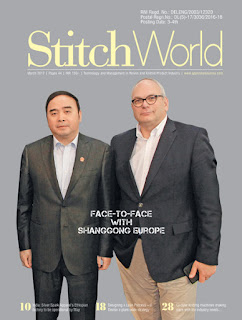
In a new series starting this issue, we will bring to our pages the leaders driving the innovation in the industry. The first part of the series is an excerpt of the discussions I had during a recent tête-à-tête with the management team of the ShangGong Group, which has acquired some really big names in European technology, including Duerkopp Adler.

During my regular visits to Bangladesh, I have noticed that the country is fast moving towards high-end technology, much more than compared to India, though India is the largest importer of sewing machines today. While India is importing a lot of basic machines, established brands are very happy working with Bangladesh for their automated machines.

It seems that the garment export industry in India has reached a plateau and now the domestic market is at the stage which was occupied by export market in the early 80s, providing good opportunities for technology providers to work in large numbers, but in basic machines. Perhaps that is why we see large number of domestic players at technology events in India these days.

I hope it is not the end of growth for the garment export industry… There has to be a lot more juice left in the industry than generally perceived. The drive to skill people in huge numbers for the sewing industry and the overtly active State Governments inviting industry to set-up units for exports with lucrative incentives, will surely not let the export industry die out.

This is one editorial in which I have not offered any solution, but only raised my concerns… If you think otherwise, please send me your views.
In the meanwhile, we bring to our readers another edition of StitchWorld which is a gamut of technology and management tools. INH Quality Management by Groz-Beckert facilitates an interconnected process for the entire history of a needle from its entry into the company through the documentation of needle breakage to the point at which it leaves the factory in a recyclable condition.

Our content remains incomplete without the experts sharing their valuable strategies and experiences. Piyush R Vyas and Anand Deshpande are there in the issue to share on how to reap the advantages from implementation of lean, not only benefiting the factory, but Indian apparel industry as a whole.