Showing posts with label Garment Machinery. Show all posts

Thursday, June 27, 2019

StitchWorld Editorial Issue June 2019

The stagnation seen in apparel imports by both the US and EU this year is severely impacting the manufacturers in south-east Asian countries. Players in Bangladesh, Vietnam, Sri Lanka and to some extent India are now earnestly vying for the space being vacated by China in apparel manufacturing; this seems to be the only way to grow.


Interestingly, while manufacturing in India is now increasingly being safeguarded by the growing local market fuelled by rising consumption by both expected and unexpected markets, other countries have very little to fall back on.

Even as south-east Asian manufacturers try to find new markets and better penetration in older markets, they are hit by the growing preference for onshoring and nearshoring, both of which are faraway dreams for manufacturers in this region… The advantage is definitely going to places like Turkey, East Europe and Mexico.

The reflections of this trend were strongly visible at the recently concluded Texprocess in Germany, a must-visit fair for the sewing industry. The shift in technology is noticeably on digital interventions for operational flexibility and ease of operations.

Secondly, amidst all the focus centering around automation, robotics and 3D rendering, concepts like digital factories, micro-factories, on-demand manufacturing processes, additive technology and whole-garmenting etc.,are bound to shift the business back to the West, whether in the country of retail or near to it.

The interest that lies in these concepts is obvious, and at Texprocess, the micro-factory theme stole the show with at least five factories on display. Each demonstrated how companies can adopt this concept in order to transform their factories or retail stores, and embrace on-demand manufacturing.

The event also became a launching pad for new technologies in sewing with giants such as Vibemac, Vetron and Duerkopp Adler displaying their latest innovations, all for customers’ ease of operations.

Taking a drive towards new directions, this issue of StitchWorld looks at the cloud based solutions that are revolutionising the merchandising process to save ample amount of resources, money and time, resulting in higher efficiency and shorter lead time. The article highlights how global leaders like Tukatech, Gerber Technology, Lectra and Simbus are transforming the fashion industry with this innovative cloud based model.

Another interesting article for our readers this time is on sports bra, a challenging garment that demands support and shape of breasts in dynamic conditions (especially bouncing). The team analyses the Maaree Smart Sports Bra, delving deep into the innovative pattern of engineering and construction that goes behind it.

Tuesday, May 7, 2019

StitchWorld Editorial Issue April 2019

StitchWorld magazine has just turned sixteen, a sweet journey that started in 2003 with technology and management for the sewn product industry. Its journey in the last five years has been very eventful due to various pressing changes in the industry and the technology ecosystem. The industry has grown beyond our thinking, and keeping pace with the industry we have also expanded our coverage to include woven, knitted as well as stitchless products and technologies alongside our core sewn product industry.

While Industry 4.0 is poised to revolutionise the technology offerings for the industry with smart factory in the horizon, garments are also getting smarter with each year passing-by. We have been covering Industry 4.0 technology very extensively during the last two years with encouraging response from the industry.

 Smart garments are part of the wearable technology system that are showing promise to disrupt the garment manufacturing industry. The way athleisure has disrupted the performance wear category, smart garment will do the same to commodity wear as well as luxury segment.

According to Wearable Technology Group, the three most dominant wearable technologies sold to consumers in 2018 have been smart watches/fitness trackers, earbuds/headsets and smart patches. Nevertheless, the growth of smart garments (from being negligible in 2018) will be faster going ahead than other categories and is likely to integrate with smart patches to form the single biggest category by 2023.

In our teaser article on smart wearables in February 2019 issue, we had reported how garments are merging with gadgets and stealing the limelight in world’s premier showcase CSE 2019. Keeping pace with the future and offering value to our esteemed readers, we have decided to cover smart garments also as a regular feature in our magazine from now onwards. The lead article by Prof. Prabir Jana (NIFT, Delhi) talks about an interesting concept about the use of wearable technology in workplace for augmenting planning accuracy.

Apart from wearable technology, our focus on sustainability is also highlighted in an article based on ‘waterless’ dyeing technology which talks about the eminent names supplying this technology. In a bid to continue with the retail technology write ups, this issue also entails how chatbots and artificial intelligence tools, designed to convincingly stimulate human conversation, are making a difference in the apparel retail industry.

We hope you will enjoy our new foray into wearable technology and smart garments; also please write back to us with your suggestions as well as report any interesting developments happening in the smart garment space.

Wednesday, April 3, 2019

StitchWorld Editorial Issue March 2019

Already so many garment manufacturing technology fairs happen in India, but the focus is still not realistic India is a mega country with diverse needs and every state is as big as Bangladesh if not bigger, so why question the number of garment manufacturing technology fairs happening in India…


Looking at it from another perspective, each Indian state has so many garment manufacturing hubs that every one of them deserves a separate fair… consider Meerut, Panipat, Jaipur townships in North of India that are still unrepresented at such fairs, and on similar lines, there are many townships in South and East of India which require a technology fair to bring the local industry up to date on latest hardware and software technologies.

The understanding is that these townships comprise smaller players whose needs are also met by very basic technologies, and at most through automation at basic level.

But the factors that are still ignored at these technology fairs are the technologies of the future and the knowledge forum, which start with Industry 4.0, moving on to AI, Data Analytics, VR, additive technology to robotics… a missing platform for understanding how these new systems/ technologies are going to impact the way the industry will work in the future.

Though technologies and discussion forums need not be part of every technology fair since only the big and organised companies would be keen to take cognizance of the newer set of systems and processes at present; for them, having one big technology fair which showcases a route map for the future in any one place within India would be very much reachable.

If today, we do not start updating ourselves on such solutions, in no time, we will find that the industry is left with only small producers that are largely unorganised and unable to cater to the demands of the growing retail in India… Hence, leaving the space empty for import of garments from global manufacturers that are hungry for work and are ready to invest time, energy and resources to meet the needs of an evolving Indian retail market

We are very clear on the future directions and soon you will find StitchWorld fulfilling the role of guiding the industry to address the future… a future which is sustainable and growth-oriented!

Monday, January 14, 2019

StitchWorld Editorial Issue January 2019

New Directions for Industry in 2019
Starting a new year always brings in a sense of nostalgia. Besides reviewing the year gone by, it is a fulfilling experience to seek out directions and potential growth areas.

In technology, the one movement that I see as a potential trend going forward is the willingness to invest in robotics for factory management. Using robotics in sewing may still be far away but garment manufacturers have started looking at home-grown robotic systems in transportation, to save on labour.


Recently, Pearl Global installed robotic systems at its Chennai factory and is very optimistic of the results. I am sure many more factories will follow lead and invest in similar technologies. The days are gone when labour was abundant and cheap… now cost efficiencies are also dependent on how much labour saving can be done.

Another movement that I strongly see in the garment industry is what I had predicted years ago – the convergence of markets into one big marketplace. For a manufacturer, a market is one that is profitable and not necessarily an export market.

There is no debate on the fact that apparel buying in Western world has slowed down. Whereas the share of spending on clothing and footwear in total consumer spending in India is 6.7 per cent higher than what is seen in the US (3 per cent) and the UK (5.7 per cent). Also, the year-on-year expenditure growth in India at 12 per cent is more than double the anticipated global rate of 5 per cent.

In this scenario, is it not more viable to work with the Indian market rather than struggle with issues that are not really in the hands of the manufacturer, to be competitive in the export market, even as the market shrinks!

Every industry observer knows that the garment exports have been hit by many factors over the last two years, starting from demonetisation leading to liquidity crunch, followed by GST implementation and reduction in duty drawback rates. This is in addition to increase in wages of all these leading to the increase in cost of manufacturing.

The impact has been even greater due to the lack of any trade boosters such as the FTA with Europe. These factors, put together, have been a dent in competitiveness, of the global export industry in the past few years.

But last year, the impact of all these negative factors evened out, as GST refunds started coming in; the liquidity issues decreased and exporters learnt the hard way of how to survive on practically no duty drawbacks.

However, the factor that really brought cheer was the depreciation of the rupee, which meant that Indian exporters automatically became cheaper, without any extra effort.

This year has started on a positive note with crude prices, currency and other external influencing factors being stable. But the reality is that export is now very competitive and uncertain, so the best bet today is to address the challenges of local market and grow the business.

Monday, November 26, 2018

StitchWorld Editorial Issue November 2018

China leads the way to ‘intelligent factories’

If India is thinking to ‘catch up’ with China in the near or distant future as a manufacturing destination… I very much doubt if that is possible!

While we are still caught up in generating employment at the grass-roots, Chinese manufacturers, with the pro-active support of the Government, are focusing on ‘intelligent sewing’ and ‘smart manufacturing’ concepts that are way beyond what Indians are looking at.


We all know that the most advanced machines and equipment from practically any industry are already being made in China and more interestingly, even in those jobs that require ‘hands’, China is thinking far ahead of other countries…

I can speak from my experience in the apparel industry… today not just the garment manufacturers but also the sewing machine manufacturers too are opting for automated manufacturing concepts and even robotic systems.

Though there are 800 sewing machine factories (it was around 2300, 10 years back) in China today, the movement is towards consolidation to bring the numbers lower but with better technology and higher precision, so as to control the entire world’s sewing needs.

The process has already started with identification and support to two major companies from China, capturing the best and most established European sewing machine manufacturers… bringing them into their fold. I am almost sure that in the next five years, the Japanese will also sell out to the enterprising Chinese companies and leave the garment machine manufacturing space, entirely to China.

The next phase of eliminating ‘hands’ has also begun, majorly to address the increase in wages that impacts competitiveness, by funding the ‘smart’ movement in earnest. The movement is not just about digitising the industry, but also about cutting the unnecessary cost and creating systematic changes… in other words, building ‘intelligent factories’ of the future.

The same was evident during my team’s visit to the leading Chinese sewing technology provider Jack which had a number of innovations to show to its visitors inside its ‘first intelligent factory’ of China. The company is a trailblazer in sewing machine manufacturing and visiting the factory was an eyeopener.

Since 2016, Jack has been organising Annual Overseas Distributors’ Meet and StitchWorld has had the privilege to be a part in all the editions. The way Jack hosts its hundreds of guests who come from all across the world is really commendable and appreciable. It only goes on to reflect the thought process of the company, which is well sorted and systematic!

Though industries such as automobile and IT have already started building smart factories in order to digitalise their processes and to keep a watch on every incident in real time, it is only now that the apparel industry is sensing the need for such factories to combat the rising cost challenges and avoid miscellany of information which they face due to the traditional approach. In this issue, we have covered an article based on expert opinion from garment and steel industries to know the practicality of smart factory concept in the apparel manufacturing sector.

Tuesday, September 25, 2018

StitchWorld Editorial Issue September 2018

Positive, Domestic Market Growing

Last month was a very busy month for us, with the dates of both Gartex, New Delhi and GTE, Bangalore clashing. It created quite a chaos for some companies that would have liked to be at both the places, but overall, the fairs were successful.

Though the focus of the two fairs was different, the feedback from the industry was very similar. At Gartex, the emphasis was on digital technology, embroidery and denim, while GTE was mostly about sewing technology. And, both fairs saw good visitation along with a significant presence of the domestic market which was noteworthy.


The fairs revealed that the domestic market is thriving with opportunities and not only have the bigger manufacturers upgraded themselves, but even smaller units are looking for growth avenues.
It was enlightening to talk to these small, often considered marginal players, to know about their keenness to explore new technologies, specially in the value addition segment, which was indeed amazing. Many of them actually placed orders for digital printing technologies!

As for the exporters, they also came, but their attitude was more cautious and reserved. Enough has been said on the role or rather on the absence of a role, by the Government, particularly of the textile ministry supporting the industry in its time of need. The good thing that has come out of all this is that the industry has finally come to terms with the fact that they have to pave their own road rather than just waiting for things to happen.

It is obvious that the industry has evened out and only those who are ready to change will remain and prosper. Opportunities are floating, but grabbing them requires a strong mindset and a competitive manufacturing set-up. It was good to see a more practical industry, ready to take on the challenges.

A technical review of both fairs can be found in the following pages of Stitch World. Besides these reviews, some of the other interesting analyses include an ever-raging discussion on the performance of men vs. women at work. For any other industry, the views are very subjective, but on the shop floor, women sewing operators seem to have emerged as clear winners. Read on to find out what the industry thinks…

Check shirts are men’s favourite, be it casual style or formal… every male has a check shirt in his wardrobe. The beautiful, symmetrical checks take the maximum time in cutting department due to mitering requirements in different areas of the garment. While mitering or matching of checks (in different parts of the shirt) enhances the aesthetics of the shirt, some become a nightmare (the ones which are made symmetrical to create brand identity). Dr. Prabir Jana, Professor, NIFT, Delhi questions some of the critical parameters of shirt making in the article ‘Shirt Making: Technical Excellence or Design Nightmare’.

Another important topic touched upon in this issue is on the ease of PMTS solutions. While one requires a formal training to operate the time and motion study software, timeSSD breaks all such barriers with an interesting experiment conducted among NIFT students.

Tuesday, August 14, 2018

Stitch World Editorial Issue August 2018

Delhi High Court’s Rejection of Wage Hike Brings Relief to the Industry Bringing relief to hundreds of factories in Delhi, the Delhi High Court has dismissed the State Government’s move to increase minimum wages of workers and has also set aside an earlier notification by which a Minimum Wages Advisory Committee for all scheduled employments was set up, on the ground that the constitution of the Committee was flawed.


In my interaction with factory owners, I find that no one is really against the rise in minimum wages, but all are of the opinion that there has to be a balanced approach to the ‘calculation’ that safeguards the competitiveness of the factories… I completely agree with this logic.

In fact, even during our visits to Bangladesh, the same logic is put forward by the industry there… The Government, NGOs, unions and associations, all need to sit together to find the best formulae to calculate minimum wages as per cost of living and practical implications to business… After all if factories close down, whose purpose would it serve?

I was extremely satisfied to read the content of the Court proceedings, as it reflected the maturity of the decision makers and the balanced approach taken - The Court noted that though the revision of wages ‘is sorely needed’, the ‘hurried attempt’ and ‘non-application of mind – contravening principles of natural justice has unfortunately disrupted this course, yet again’ …

The proposed notification for wage increase announced in 2017 envisaged a more than 37 per cent increase in wages across the board from unskilled to semi-skilled and skilled workers in the Delhi-NCR region. Since the announcement, factories were fearing about future business, and particularly exporters who are competing on an international platform… The High Court’s decision is indeed a reason to cheer and could be the required jack to uplift the dwindling spirits of garment exporters in the region. While increasing wages are a challenge at the worker level, finding the right candidate at the managerial level is no less daunting. During placements, both the students and companies are evaluating each other. While students go by a company’s reputation, the companies are increasingly using psychometric test as a tool to measure a person's logical and analytical abilities.

Though psychometric tests support the recruitment process, sometimes it becomes difficult for companies to decide on the weightage to be given to technical ability and psychometric scores, in the selection process. In this issue, views of industry professionals on this growing topic are discussed.

This issue also carries an exclusive interaction with Ashish Kansal, Executive Director, SMPP Pvt. Ltd., that unravels features which make the newly procured Indian Army jackets unique. On the other hand, Dr. Prabir Jana, Professor, NIFT, Delhi explores the operation breakdown of exactly the same shirt in two different factories. The logic is simple…, when the product remains standard, why is the process so different?

Subscribe the Magazine here: https://goo.gl/pXNmBD

Monday, April 9, 2018

Stitch World Editorial Issue April 2018

Even as manufacturing technology moves into the Industry 4.0 zone, one cannot ignore the rapid intervention of technology in retail. The whole process of sourcing, manufacturing and retailing is undergoing a dynamic revolution, and technology is at the centre of this change.

Everyone is talking about e-retailing and how it has challenged the retail landscape, but a number of interactive and responsive technologies are actually enhancing the in-store experience, which is one of the most important attractions for the millennials today.

From this issue onwards, StitchWorld is introducing a new section, specially for retail technologies. It is an acknowledgment to the growing number of technologies that are aimed at the retail segment.

It is only appropriate that after working so hard to support the manufacturing industry in understanding and developing effective systems for the back-end, SW now takes a step forward without moving from its primary focus on the ‘sewn product’ industry.

The series of articles will throw light on new directions in retail and how technology is providing the solutions. The first article in the series is on the concept of ‘Magic Mirror’ which captures much more than the onlookers’ image.

I am sure my readers will find value in the series and I look forward to suggestions on technologies and topics we can talk about in this new section.

The current issue also contains a special tribute to women in the Tech Industry. Though they are fewer in number, the ‘punch’ they carry is no less than that of their male counterparts. Federica Giachetti, President Morgan Tecnica, shares her journey in a man’s world and how today, she is not looked upon as a woman, but as a successful entrepreneur.

Ludhiana is going through a dynamic change… while players are now exploring new products like lingerie, hitherto unheard of in the city and are moving beyond the knit centre title; new technologies are coming in and the openness to adapt to these technologies is on a high.

Bringing in this change with enthusiasm are a set of new generation inheritors and more affordable technology that suppliers are offering from around the world. The synergy between the willingness to change and the expanding offerings is writing a new chapter in the evolution of the Ludhiana industry.

Friday, March 16, 2018

Stitch World Editorial Issue March 2018

Industry 4.0 is very much in the news and also a hot topic of discussion in magazines and seminars, the world over. We are also following the market trends and discussing the many facets of this topic in the pages of StitchWorld. In this issue too, we bring you insights into the latest discussion on agendas covered by experts sharing the multiple benefits that Industry 4.0 offers.


It is another matter if we would be using any of these concepts in apparel manufacturing and in the context of the Third World countries, in the near future. But then, apparel is not the only industry using sewing technologies. It's being used in industries manufacturing products right from water rafts, parachutes, sails, airbags, tents to all other industries which are using technical textiles as a substitute for hard materials. Significantly, products being manufactured by these industries require high precision and speed and for which the price of the product is not so much of a constraint.

Understand that the concept 4.0 is presently at a very early stage of evolution. It will take few years for it to settle down with a definitive direction. SW is also transforming and growing with the evolution of this concept. That's what we as editors of StitchWorld do, keep a close watch on the evolving trends.

Many years ago, we caught the concept of ‘Lean’ in the apparel manufacturing industry at a very early stage and covered it intensively from all dimensions in our pages. Today, we are bringing out a book on 'Lean concept and its implementation in the apparel industry’ with case studies based on the articles published in SW from time to time.

On similar lines, you would be seeing many books and reports in the next couple of months… This is the fruit of our efforts to compile concepts, formulated and discussed over time and at length, in one comprehensive format as an easy reckoner for practitioners and students of the industry.

The current issue of SW brings to you some interesting technologies that drew attention at the recently concluded GTE. In addition, you will also get an insight into Utah Fashions Ltd., a Bangladesh based apparel exporter that has been carving a benchmark in lean with the practices it follows. Following the growing importance of fire safety, Team SW also brings out the vulnerabilities in factories which lead to fire accidents.

Friday, February 9, 2018

Stitch World Editorial Issue February 2018

January month has always been a busier month hustling with activity and business owing to multiple technology trade fairs being held around the same time in both India and Bangladesh. What makes it even more interesting and spirited is the opportunity that it gives us to meet several old and new acquaintances and get the real pulse of the industry… undoubtedly, this time also I was successful in drawing many leads.
However, what perturbs me still is the industry’s ‘not-so-vibrant’ scenario, as they continue to struggle under the ongoing product-price war, and are even more badly hit due to bank’s tight lending, thanks to the NPAs and the GST, and the final nail in the coffin being the abolition of duty drawback.

Nevertheless, I was elated to come across few exporters who managed to put up a good show amidst such testing times… Here my special mention goes to Magnum Resources, a technology supplier, whose stall at GTE Delhi, apart from giving a feel of international styling also depicted the prosperous time it saw last year. From next year onwards, the company intends to take a bigger leap by not only having a larger stall but also a double-storey set-up. I must compliment their consistent courage and determination which has made them emerge as a winner in this sluggish position.

The twist in the tale was ‘automation’ or as I should say more emphatically ‘affordable automation’ which stole the show. Certain automats like cuff runstitch, collar runstitch machines, which have made their presence felt since last three decades, are finally finding a place on the shopfloor. We may have been still far from Industry 4.0 compared to the West, but automation has silently crawled its way to become an integral need for our industry’s successful survival in face of rising cost and labour crisis.

What continues to concern me though is the absence of newcomers in such potential events. I have kept harping on this time and again as I don’t get to see the new generation coming to these fairs, lacking the required inquisitiveness towards developments with regard to the industry. Now I don’t even chance to meet the regular generation next… Is this not sad?

All said and done, apparel may not be doing well but non-apparel products are already on their growth path, and as per my understanding and information, the major expansion is taking place in this segment. StitchWorld definitely endeavours to have more such nonapparel products such as gloves, backpacks, wallets and more on its pages for its readers… Our next issue will update you on the detailed happening in the technological front and their implementation in India and Bangladesh.

If you don’t know yet, my company Apparel Resources has recently released a book Industrial Engineering in Apparel Manufacturing and has also used GTE as a launching pad for our Apparel Resources Jobs portal… Don’t miss further information on these new ventures in our upcoming Apparel Online magazine and our website apparelresources.com.

I must admit that I have stated only a small fragment of the vast pool of thoughts which surround me, and more will be shared with you shortly…

Wednesday, August 2, 2017

Stitch World Editorial Issue August 2017

Participating in exhibitions is always a learning experience and being at Gartex 2017 was really an exciting experience after a long time. Though these are tough times for the industry, still they all came in large numbers to the fair with the hope for finding something new and different.
I met many owners, CEOs and senior management from export houses from across the country. Gartex 2017 saw participation of companies like Orient Craft, Eastman Export, Blackberry, KK Overseas (Jaipur) and companies from as far as Kolkata, Dehradun and Mohali. This was inspiring considering the fact that the market for both the segments is not at its best. The exporters and domestic manufacturers are all struggling to come to terms with the effect of demonetisation and GST. Both these policies have reduced money flow in the market and increased the need for working capital, affecting business at various other levels too.

Through candid interactions with all these companies, I found that though no one was really complaining that the policies are bad or not good for the country/industry, the main grouse was that many grey areas still exist and there is no clarity on many critical areas – mostly related to 18% GST on job work in the apparel segment. While those exporters who have all value adding capabilities in-house will be at an advantage, the middle level and smaller exporters who are dependent on contractual job workers for their value-added processes will have to bear the increased cost...

The other concern being reduction in duty drawback..., most exporters have come forward to discuss how the drawback was their only saviour amongst the several impediments and had helped to keep their balance sheet in black. But now with the reduction in the duty drawback to 3 to 4%, even this last expectation is gone.

With Surat being practically closed from the beginning of July and growing fear of another round of strikes, the supply chain has been hit badly. Deadlines are going for a toss and hectic lobbying is going on to break the deadlock.

For domestic manufacturers, since many markets are closed, demand is slow since June. And it is no secret that both the US and EU are facing difficult times…, yet the positive part is that the industry is keen to explore new technologies which will help them to become more competitive on value, and the quality visitation at Gartex is proof of the same!

Tuesday, July 4, 2017

Stitch World Editorial Issue July 2017

A change is inevitable now. All because of the few incidents that have happened or are going to happen…

Last year was the most uneventful year for exports in a long time…, maybe it was a year in brooding. The export growth figures were down and the domestic market was depressed due to demonetization and fear of GST (some are comparing it to the Y2K virus, which created such a hype at the turn of the century but fizzled out to nothing).

I believe that fear is bigger than reality…, yet there are genuine concerns, mainly because of the lack of clarity and implementation hurdles. In the meanwhile, the textile industry is divided on how the reforms would impact businesses along the supply chain, though there is a conviction that it would have a positive influence on the competitiveness in the long run.

The recently concluded Textiles India 2017 extravaganza was a breeding spot for discussions and the four major concerns with regard to GST that emerged are: Accumulation of credit at every level of the chain; Imported fabric to be cheaper than domestic fabric; 18 per cent service tax on apparel job work to make outsourcing unviable; and 18 per cent GST on MMF and Yarn serving as a severe blow to the synthetic sector.

Though the Government has assured a review and revision after three months, the industry is on the back foot. While demonetization brought in lack of funds to source raw materials and pay wages, GST has brought uncertainty, thereby further crippling the system.

As if this was not enough, the Delhi Government has increased minimum wages by 50%... I am not even sure if the industry can survive after such a huge blow… Where are the margins to absorb this increase?

Though the honourable court has reserved the decision till 11th September, I doubt if the court will eventually ‘stay’ the move.

With all this happening, the only way to survive is to move to places like Jharkhand, Odisha, Telangana and other states where the Government is pro-active in building infrastructure and is offering incentives to the industry to come in, including a rebate on wages. Jharkhand already has three bigwigs setting up units there – Orient Craft, Shahi Exports and Matrix Clothing…, and I am sure others will follow suit soon.

I sincerely believe that this is the best and the only way for the industry to grow now!

In the meanwhile, things are getting tough on the retail front also with stores closure and frequently changing consumer demands putting pressure on retailers to be faster than their competitors in placing their products on the shelves. Ram Sareen, Founder, Tukatech shares with our readers how the long sheets of tech packs cannot keep pace with the evolving fashion industry. It is the digital platform that should be the new communication language between designers and technical team. Longer the retailers rely on outdated means, sooner they will be out of business.

Another trend which is taking fashion to a next level is ‘athleisure’. Driven by millennials’ fitness-conscious behaviour, athleisure is the new take of the town. Fad or classic, athleisure is not going to lose its charm in the coming years. Two of Indian sportswear manufacturers, Paragon Apparels and Creative Clothex, have launched their own athleisure brands in the market to tap the potential market in India

Monday, June 12, 2017

Stitch World Editorial Issue June 2017

At Texprocess, Frankfurt, Germany, besides meeting a lot of old friends and colleagues from the industry, all that I heard there was ‘Industry 4.0’… Every technology provider was talking about concepts like Internet of Things, additive manufacturing, manto- machine communication, machine-to-machine communication, SaaS, smart manufacturing, and artificial intelligence – each concept an integral part of the term Industry 4.0.
Many of the technologies I saw were tailor-made for western countries where labour is a scarce and expensive resource. The idea behind many of the machines was to eliminate human intervention and fully automate processes from design to production and in some cases even include retail and logistics.

So, does that mean Industry 4.0 is actually about taking production back to the West…? I have my reservations on how relevant Industry 4.0 is for the manufacturing world today. Even before automation has properly been adopted in Asia and other developing nations where production is happening, the focus of technology providers is already shifting to the next phase without fully perfecting the automation stage and making it suitable to the needs of the countries that are leading production today…

Can the technology providers afford to ignore the requirements of these manufacturing destinations, which are their biggest selling markets…? I don’t think so! In reality, the Texprocess platform is about the future, though in manufacturing countries the push is still on selling automation.

Most industry experts agree that the future is still a mystery and difficult to predict, what’s sure is that it would be very different from today and if companies do not start preparing now, they would be wiped out of business…

Our analysis of Texprocess is an attempt to decode Industry 4.0 as the debate gets louder… The same will continue in the next issue where many more technologies including IT solutions will be featured.

Even as technology providers move into the future, in a wave of retail bankruptcies, over 8,600 retail stores closure is being projected. Consumers are shifting a greater percentage of their disposable income to ‘experiences’ rather than ‘shopping’, creating an ‘adapt or die’ situation for retailers. Ed Gribbin, President, Alvanon Inc. suggests some of the ways through which retailers can sustain in a competitive environment.

Another interesting read in this issue is WFX Cloud ERP that has integrated new features into the solution such as ‘Analytics’ tool, which enables control over complete supply chain, and ‘Alert System’ that notifies the user before the deadline. Also, the second part of Kaizen Korner series addresses Lean Manufacturing, where David Permenter, Educational Director, DCC Print Vision LLC, tells how to identify waste and eliminate it.

Friday, April 7, 2017

Stitch World Editorial Issue April 2017

May is going to be an interesting month for me as I will be attending Texprocess in Frankfurt, Germany…, something that I really look forward to.

Somebody, sheepishly asked me why visit Texprocess when such technology fairs take place in developing countries also…? My answer was simple: “Texprocess is the only international technology trade exhibition of our industry which is a ‘distinct depart’ from the basic technologies that one sees everywhere, at almost every fair happening in any part of the world!” It is not only the range of products that makes it impressive, but the advancements in each process which is a ‘value creation’, makes the fair a must-visit for those looking to understand< the future of the industry.


The Digital Textile Micro Factory, which is a live demonstration of apparel production chain to address the needs of small batches or even one-piece orders, is definitely something that the industry will find interesting at the fair.

Another special experience at the show will be the ‘Living in Space’, a part of Techtextil, which happens concurrently with Texprocess that will showcase a wide variety of applications for technical textiles in space travel together with the processes involved.

On a recent visit to India, Michael Jänecke, Director, Brand Management, Technical Textiles & Textile Processing, Messe Frankfurt Exhibition GmbH presented me with a beautiful pen drive in the shape of a space traveller wearing a space suit and also handed over space food, which travellers eat when in space… Nowhere else can I get such an experience… Only at Texprocess in combination with Techtextil we can even expect something so unique!

Going by the trend to think futuristic…, the next issue of StitchWorld will carry two articles of utmost importance. One is on Robotics – Innovations in these disruptive times by Frank Henderson, President, Henderson Sewing Machine and Dr. Prabir Jana, NIFT Delhi. The other on practical application of 3D printing of sewing machine parts, which will not only reduce time wasted in finding the correct spare part from the inventory but will also empower SMEs to 3D print the required part/attachment near the point of consumption, thus reducing their dependence on agents for machine spare parts.

The futuristic concept has become so big that the same is also the theme of this edition of StitchWorld. Whether we talk about the digital feed in sewing machine in which brands like Brother, TYPICAL, Juki and Duma are coming up or web-based solutions offered by Lectra, I am sure of the fact that technology suppliers are aggressively harnessing the concept of Industry 4.0.

A detailed analysis on ‘Digital Feed in Sewing Machine’ by Dr. Prabir Jana is surely a step ahead in IoT and will provoke my readers to think upon its future benefits. Following the series, where we exclusively interact with industry leaders, this issue carries a detailed discussion with Daniel Harari, CEO, Lectra on the ‘future’ where he throws light on technology acceptance in India, Bangladesh and Vietnam, and shares about the SaaS model, introduced by the company.

The current issue of SW concludes the three-part series by Anand Deshpande in which he has explained the strategies to implement Lean process in a factory.

Monday, March 6, 2017

Stitch World Editorial Issue March 2017

The buzzword today is Industry 4.0… Every international forum, seminar and trade fair is discussing and deliberating on disruptive innovations such as IoT, M2M, Vision Systems Integrated Sewing, 3D Sewing, and Robotics. The topics are relevant today in the wake of efforts by Western countries – the US and Europe - to bring back the sewing industry… I think the industry is on the cusp of evolution since the talk on such subjects is overwhelming.

 Stitch World Issue March
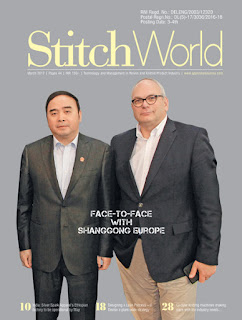
In a new series starting this issue, we will bring to our pages the leaders driving the innovation in the industry. The first part of the series is an excerpt of the discussions I had during a recent tête-à-tête with the management team of the ShangGong Group, which has acquired some really big names in European technology, including Duerkopp Adler.

During my regular visits to Bangladesh, I have noticed that the country is fast moving towards high-end technology, much more than compared to India, though India is the largest importer of sewing machines today. While India is importing a lot of basic machines, established brands are very happy working with Bangladesh for their automated machines.

It seems that the garment export industry in India has reached a plateau and now the domestic market is at the stage which was occupied by export market in the early 80s, providing good opportunities for technology providers to work in large numbers, but in basic machines. Perhaps that is why we see large number of domestic players at technology events in India these days.

I hope it is not the end of growth for the garment export industry… There has to be a lot more juice left in the industry than generally perceived. The drive to skill people in huge numbers for the sewing industry and the overtly active State Governments inviting industry to set-up units for exports with lucrative incentives, will surely not let the export industry die out.

This is one editorial in which I have not offered any solution, but only raised my concerns… If you think otherwise, please send me your views.
In the meanwhile, we bring to our readers another edition of StitchWorld which is a gamut of technology and management tools. INH Quality Management by Groz-Beckert facilitates an interconnected process for the entire history of a needle from its entry into the company through the documentation of needle breakage to the point at which it leaves the factory in a recyclable condition.

Our content remains incomplete without the experts sharing their valuable strategies and experiences. Piyush R Vyas and Anand Deshpande are there in the issue to share on how to reap the advantages from implementation of lean, not only benefiting the factory, but Indian apparel industry as a whole.

Monday, February 13, 2017

Stitch World Editorial Issue February 2017

An interesting beginning to the year is the growing number of ‘technopreneurs’ – people who have garment manufacturing education and are now starting business on their own… I have met some of them recently and am very happy with the development.

I have always said in my earlier editorials that unless we have the new generation coming forward to establish factories, this industry will wane away. And now I have a hope that the industry is on a strong footing because my list of start-ups is growing.


For me it does not matter whether the start-up is for exports or domestic manufacturing… A start-up in garmenting is what is important. At least these young professionals are getting into the business on their own…, willing to manufacture garments, which even older players are finding difficult to do!

I would wish to extend them any help if they would want from us, to see them grow and progress to be the next Shahi or Orient Craft… If you know any such start-ups, do connect them to StitchWorld, we would love to welcome them into our folds.

We have also recrafted the StitchWorld to suit their needs… When I say recrafted, I mean the focus is now clearly on benchmark practices, new models of operations, more automation and robotics and not to be ignored of innovative ways to manage and motivate employees. Emphasis is also on career building and sustainable initiatives.

I look forward to your suggestions to be more targeted and valuable to my readers.
In line with our new editorial thrust, an interesting article is ‘Entrepreneurship: Transformation from Learning to Execution’ wherein Sanjay Yadav shares how his experience on the shopfloor at other factories and education helped him in setting up his own unit.

 In the article – ‘Anatomy of an Efficient Apparel Production Manager’, the traits and the deliverables of an ideal production manager are discussed in detail. This is particularly important as the foundation of an efficient apparel manufacturing setup is led by production, and the production manager is the critical bridge between the company’s financial goals and workers.

We have also initiated a new series wherein SW will present ‘Top-List’ technology providers in different segments used in apparel industry processes. The section aims at analysing the best available in the market.

Friday, January 6, 2017

Stitch World Editorial Issue January 2017

StitchWorld is in its 14th year, and has evolved tremendously in its content and reach. We have graduated from topics like operator and supervisor training to concepts like IoT, M2M and automation, moving towards Robotics and the era of 3D printing and 3D pattern making. Yet, the focus of the magazine has not changed at all - productivity, on-time delivery and quality - still remain at the core; how to achieve these goals are evolving, resulting in new concepts and management tools.
Today, managing a factory is a very complex game; it is no longer about just building a state-of-the-art factory. How the factory is managed, and what are the external influences and challenges of profitability are critical elements that can make or break even the best of factories… Through the year, my editorials have reflected these challenges…, emerging from factors both within and outside the factory.

It all sounds very nice, but the industry is taking a cautious stand… They know that Governments don’t really understand the nuances of the industry, and just by giving incentives to set-up a unit is not going to help the cause. I have pointed out many
times that the issue is inter-related to many concerns… In my editorial in February, I had said, “The three areas that need attention are ‘Clean India’, ‘Healthy India’ and ‘Corruption-free India’. If these three areas are taken care of, all other requirements for sustainable growth of manufacturing will follow automatically.”

Another interesting point that evolved over the year and strongly advocated by the stalwarts of the technology industry is that automation alone is not the answer to labour issues… They emphasize on the need to balance automation with motivation. I fully endorse this view and we are almost ending from where we started - operator training; only the focus is not so much on training but motivation!

I had pointed out in my September editorial that too much automation is not a solution, it has to be selective automation on those operations where replacing the labour makes sense. After all it is about replacing labour wages that cost rupees per month as against western countries where the equation is in dollars per day.

External influences like terrorism, Brexit, US elections have all been contemplated on, and 2017 will see how these events of the past year will push business interest. New innovations, technology service outsourcing, re-shoring and new global manufacturing destinations like Ethiopia and Myanmar have all found place in various editorial musings… But what I would like to say fresh is that the time has come to reassess the scope of StitchWorld - sewing industry is now too big to be limited by the literal context.

This year we propose to re-orient focus within the gamut of garment manufacturing and management. The new focus areas besides the core subjects of production technology and production/product management will be on: Technology 4.0 that will talk about future technologies; Information Technology - a rundown on latest offering from the segment; Global Sourcing - acknowledging that manufacturing in one country is a culmination of sourcing from various destinations; Sustainability - the future no doubt; HR Management - a step upward from pure labour issues; Value Addition - creating differentiation for companies and countries; and finally Knitting Technology - a reality check, recognizing that garmenting is both
about woven and knitted products.

Friday, December 9, 2016

Stitch World Editorial Issue December 2016

The more countries I visit, the more I realize that the problems faced by the industry are more or less the same… It is just the culture of the place and peoples’ happiness levels and aspirations that make the small differences in productivity and efficiency levels of the factory.

I have closely observed the industry in India, Bangladesh and now Vietnam…, and one thing is very clear, factories in all these countries need technology management interventions at all levels.


Though there are only a few Vietnamese apparel manufacturing companies in Vietnam with production being dominated by the Chinese, Taiwanese and Korean companies, the problems in terms of management are the same. My understanding after talking to some experts working in the industry is that irrespective of where the country of origin is, all require some kind of production management intervention, similar to what Indian or Bangladeshi companies require.

On the hindsight, it seems that although most of the countries from where garmenting has shifted from – like Korea, the US, Europe and even Japan – have progressed immensely as nations, but garment factory management skills have remained at the same level when they left the country… Case in point is the numerous foreign-owned factories in Vietnam, where systems of effective management are still ‘old school’. These companies have moved out of their respective countries too long back to imbibe any new system.

Technology upgradation is easy as latest machines are available to all, but how to optimize factory resources, including the machines, is another ball game. I strongly feel that to grow, factories require latest intervention in production management as much as any other input, perhaps the need is even more…!

At StitchWorld, it is our effort to provide insights into such production management systems and tools. In this issue we bring to you an article ‘Quality Engineering – An emerging concept to ease quality worries’! which discusses in detail the concept of quality engineering as opposed to quality control as the new mantra to ensure quality of product during the production process.

The various technology interventions for button wrapping from basic machines to fully automatic ones, is the focus in our technology segment. In another interesting read, an ex-NIFTian shares his journey to create a unique business model to support designers with samples and small production runs.