Monday, March 6, 2017

Stitch World Editorial Issue March 2017

The buzzword today is Industry 4.0… Every international forum, seminar and trade fair is discussing and deliberating on disruptive innovations such as IoT, M2M, Vision Systems Integrated Sewing, 3D Sewing, and Robotics. The topics are relevant today in the wake of efforts by Western countries – the US and Europe - to bring back the sewing industry… I think the industry is on the cusp of evolution since the talk on such subjects is overwhelming.
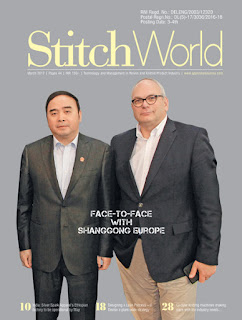
 Stitch World Issue March
In a new series starting this issue, we will bring to our pages the leaders driving the innovation in the industry. The first part of the series is an excerpt of the discussions I had during a recent tête-à-tête with the management team of the ShangGong Group, which has acquired some really big names in European technology, including Duerkopp Adler.

During my regular visits to Bangladesh, I have noticed that the country is fast moving towards high-end technology, much more than compared to India, though India is the largest importer of sewing machines today. While India is importing a lot of basic machines, established brands are very happy working with Bangladesh for their automated machines.

It seems that the garment export industry in India has reached a plateau and now the domestic market is at the stage which was occupied by export market in the early 80s, providing good opportunities for technology providers to work in large numbers, but in basic machines. Perhaps that is why we see large number of domestic players at technology events in India these days.

I hope it is not the end of growth for the garment export industry… There has to be a lot more juice left in the industry than generally perceived. The drive to skill people in huge numbers for the sewing industry and the overtly active State Governments inviting industry to set-up units for exports with lucrative incentives, will surely not let the export industry die out.

This is one editorial in which I have not offered any solution, but only raised my concerns… If you think otherwise, please send me your views.
In the meanwhile, we bring to our readers another edition of StitchWorld which is a gamut of technology and management tools. INH Quality Management by Groz-Beckert facilitates an interconnected process for the entire history of a needle from its entry into the company through the documentation of needle breakage to the point at which it leaves the factory in a recyclable condition.

Our content remains incomplete without the experts sharing their valuable strategies and experiences. Piyush R Vyas and Anand Deshpande are there in the issue to share on how to reap the advantages from implementation of lean, not only benefiting the factory, but Indian apparel industry as a whole.

Monday, February 13, 2017

Stitch World Editorial Issue February 2017

An interesting beginning to the year is the growing number of ‘technopreneurs’ – people who have garment manufacturing education and are now starting business on their own… I have met some of them recently and am very happy with the development.

I have always said in my earlier editorials that unless we have the new generation coming forward to establish factories, this industry will wane away. And now I have a hope that the industry is on a strong footing because my list of start-ups is growing.


For me it does not matter whether the start-up is for exports or domestic manufacturing… A start-up in garmenting is what is important. At least these young professionals are getting into the business on their own…, willing to manufacture garments, which even older players are finding difficult to do!

I would wish to extend them any help if they would want from us, to see them grow and progress to be the next Shahi or Orient Craft… If you know any such start-ups, do connect them to StitchWorld, we would love to welcome them into our folds.

We have also recrafted the StitchWorld to suit their needs… When I say recrafted, I mean the focus is now clearly on benchmark practices, new models of operations, more automation and robotics and not to be ignored of innovative ways to manage and motivate employees. Emphasis is also on career building and sustainable initiatives.

I look forward to your suggestions to be more targeted and valuable to my readers.
In line with our new editorial thrust, an interesting article is ‘Entrepreneurship: Transformation from Learning to Execution’ wherein Sanjay Yadav shares how his experience on the shopfloor at other factories and education helped him in setting up his own unit.

 In the article – ‘Anatomy of an Efficient Apparel Production Manager’, the traits and the deliverables of an ideal production manager are discussed in detail. This is particularly important as the foundation of an efficient apparel manufacturing setup is led by production, and the production manager is the critical bridge between the company’s financial goals and workers.

We have also initiated a new series wherein SW will present ‘Top-List’ technology providers in different segments used in apparel industry processes. The section aims at analysing the best available in the market.

Friday, January 6, 2017

Stitch World Editorial Issue January 2017

StitchWorld is in its 14th year, and has evolved tremendously in its content and reach. We have graduated from topics like operator and supervisor training to concepts like IoT, M2M and automation, moving towards Robotics and the era of 3D printing and 3D pattern making. Yet, the focus of the magazine has not changed at all - productivity, on-time delivery and quality - still remain at the core; how to achieve these goals are evolving, resulting in new concepts and management tools.
Today, managing a factory is a very complex game; it is no longer about just building a state-of-the-art factory. How the factory is managed, and what are the external influences and challenges of profitability are critical elements that can make or break even the best of factories… Through the year, my editorials have reflected these challenges…, emerging from factors both within and outside the factory.

It all sounds very nice, but the industry is taking a cautious stand… They know that Governments don’t really understand the nuances of the industry, and just by giving incentives to set-up a unit is not going to help the cause. I have pointed out many
times that the issue is inter-related to many concerns… In my editorial in February, I had said, “The three areas that need attention are ‘Clean India’, ‘Healthy India’ and ‘Corruption-free India’. If these three areas are taken care of, all other requirements for sustainable growth of manufacturing will follow automatically.”

Another interesting point that evolved over the year and strongly advocated by the stalwarts of the technology industry is that automation alone is not the answer to labour issues… They emphasize on the need to balance automation with motivation. I fully endorse this view and we are almost ending from where we started - operator training; only the focus is not so much on training but motivation!

I had pointed out in my September editorial that too much automation is not a solution, it has to be selective automation on those operations where replacing the labour makes sense. After all it is about replacing labour wages that cost rupees per month as against western countries where the equation is in dollars per day.

External influences like terrorism, Brexit, US elections have all been contemplated on, and 2017 will see how these events of the past year will push business interest. New innovations, technology service outsourcing, re-shoring and new global manufacturing destinations like Ethiopia and Myanmar have all found place in various editorial musings… But what I would like to say fresh is that the time has come to reassess the scope of StitchWorld - sewing industry is now too big to be limited by the literal context.

This year we propose to re-orient focus within the gamut of garment manufacturing and management. The new focus areas besides the core subjects of production technology and production/product management will be on: Technology 4.0 that will talk about future technologies; Information Technology - a rundown on latest offering from the segment; Global Sourcing - acknowledging that manufacturing in one country is a culmination of sourcing from various destinations; Sustainability - the future no doubt; HR Management - a step upward from pure labour issues; Value Addition - creating differentiation for companies and countries; and finally Knitting Technology - a reality check, recognizing that garmenting is both
about woven and knitted products.

Friday, December 9, 2016

Stitch World Editorial Issue December 2016

The more countries I visit, the more I realize that the problems faced by the industry are more or less the same… It is just the culture of the place and peoples’ happiness levels and aspirations that make the small differences in productivity and efficiency levels of the factory.

I have closely observed the industry in India, Bangladesh and now Vietnam…, and one thing is very clear, factories in all these countries need technology management interventions at all levels.


Though there are only a few Vietnamese apparel manufacturing companies in Vietnam with production being dominated by the Chinese, Taiwanese and Korean companies, the problems in terms of management are the same. My understanding after talking to some experts working in the industry is that irrespective of where the country of origin is, all require some kind of production management intervention, similar to what Indian or Bangladeshi companies require.

On the hindsight, it seems that although most of the countries from where garmenting has shifted from – like Korea, the US, Europe and even Japan – have progressed immensely as nations, but garment factory management skills have remained at the same level when they left the country… Case in point is the numerous foreign-owned factories in Vietnam, where systems of effective management are still ‘old school’. These companies have moved out of their respective countries too long back to imbibe any new system.

Technology upgradation is easy as latest machines are available to all, but how to optimize factory resources, including the machines, is another ball game. I strongly feel that to grow, factories require latest intervention in production management as much as any other input, perhaps the need is even more…!

At StitchWorld, it is our effort to provide insights into such production management systems and tools. In this issue we bring to you an article ‘Quality Engineering – An emerging concept to ease quality worries’! which discusses in detail the concept of quality engineering as opposed to quality control as the new mantra to ensure quality of product during the production process.

The various technology interventions for button wrapping from basic machines to fully automatic ones, is the focus in our technology segment. In another interesting read, an ex-NIFTian shares his journey to create a unique business model to support designers with samples and small production runs.

Wednesday, November 9, 2016

Stitch World Editorial Issue November 2016

Around half the population is of women in the US who earn less than US $ 15 an hour, and it has been said in an article in Apparel Online India that it is very much possible to produce fashion garments at that price… Yes, I am talking about the US! Local designers, small boutique owners, and chain stores specializing in such categories or in athleisure using technical textiles, are all either working with local manufacturers, or are exploring the potential to manufacture in the US.


Manufacturing of designer wear and athleisure wear are two very different categories, yet having common potential of manufacturing in the US. While designer wear has high margin and shorter lead time to qualify for re-shoring, athleisure has longer lead time, yet it qualifies for re-shoring based on high margin and availability of speciality raw material locally. Not to forget that the local manufacturing industry in America is presently worth US $ 13 billion.

Taking advantage, a Chinese manufacturer of casual apparel and sportswear and a big supplier to Adidas, has recently signed an MoU with the state of Arkansas to invest US $ 20 million in Little Rock and create 400 jobs paying an average of US $ 14 an hour plus benefits. This is the first time ever that a Chinese garment manufacturer has invested in the United States. The way the Government has incentivized the Chinese company clearly indicates the interest of the administration to encourage job creating enterprises. And if the statement of the Governor of Arkansas is anything to go by, then more such deals are ‘down the road’.

Made in USA and re-shoring of manufacturing has also re-kindled the automation research. Every technology player is geared up for technology laden offering. At the upcoming ‘Advancements in Manufacturing Technologies’ conference organised by SPESA, world’s leading technology solution providers will jostle for their space with new offerings. It will be interesting to see whether the offerings are aimed towards large commodity manufacturers of Asia or small and medium niche players trying their luck in re-shoring for the local designers, small boutiques, and chain stores specializing in such categories or in athleisure using technical textiles…

What’s left is the need to explore just how to use expertise to best advantage! Are there any takers…, do let me know.

Efficiency and productivity improvement remains one of the key mottos of StitchWorld and we encourage practising managers and academicians to share their experiences and logic. In this issue, Dr. Prabir Jana discusses the simple mathematical technique to improve line productivity during manpower shortage, while Jayapal Nair discusses the efficiency traps to look for.

Wednesday, October 12, 2016

Stitch World Editorial Issue October 2016

The GTE exhibition in Bangalore and GARTEX exhibition in New Delhi were held simultaneously and still were able to garner visitation, this probably is an indication of increasing depth of apparel manufacturing industry in India.

Over the years StitchWorld reported continuous increase in visitation from non-metro cities and small- and medium-scale domestic players at various machinery exhibitions, which is unabated.With Ministry of Textiles trying to take the industry to north-east, the states inviting industry veterans to establish their factories, enticing them with lots of benefits and even few of the established players venturing outside India, are also the signs of maturity... I am personally visiting the north-eastern states as well as Orissa and Jharkhand to talk to the politicians and officers, and I am glad to see the change in their attitude towards the industry...


I am quite happy to see the depth and breadth of printing solutions being displayed at both the exhibitions, which is probably indicating entry of Indian players assembling the digital textile printers in India. While direct-to-garment (DTG) and sublimation printing is domain of garment manufacturers, quite a large number offering direct-to-fabric (DTF) technology signifying a war with analogue fabric printing which is the domain of textile mills. I look forward to similar spirited display of the same at ITME India in December 2016.

While the seminars have become stereotyped and boring these days, the 4th TANTU seminar which I chaired was a ‘game changer’ one. The seminar for the first time brought together the manufacturers (converters) of technical textiles on a platform to explore and deliberate. I am happy to see the energised discussions amongst panel members and a clear roadmap of collaborative working between the industry and the academia are probably the ‘value’ that can be generated from seminars in future.

Thursday, September 8, 2016

Stitch World Editorial Issue September 2016

The latest edition of GTE at Bangalore was quite a huddle affair. Most of the companies were represented by their senior managers like ITC, Texport Industries, Madura, and this is just tip of the long and impressive list of visitors. However, this does not mean that the owner-level visitation was missing. Right from Indian Designs, Golden Seams, Gokaldas Images (from Bangalore) to Sree Santosh Garments, Tirupur and Global Mode and Accessories, Delhi-NCR were represented by their owners, creating quite a buzz among the technology suppliers. What emerged from the various discussions I had with many of them was that companies in Bangalore have created niches in their respective specialized categories based on product development as the growth engine. Also, most of the companies were happy with their growth and very upbeat of the future…


This was in contrast to the feedback I have been getting from exporters in Delhi-NCR, who have had a bad S/S ’16 season due to many reasons, among which the prime reason is the slowdown in Europe, resulting in even more demand for tighter prices… I have even heard that a company doing business of around Rs. 75 crore has lost a major account worth Rs. 50 crore because the buyer wanted a price reduction of around 20 per cent (US $ 3.25 to US $ 2.5) and has since shifted the orders to Vietnam.

Another very strong fact that emerged from my discussions at GTE was that very few exporters are willing to move out of their comfort zone, despite increasing cost of production in Bangalore. The farthest they are ready to go is to the border of Karnataka or coastal Andhra that too because the Government is pursuing them very pro-actively.

Technology providers believe that the migration into new states is a must for the garment industry to grow and many of them claim that they are supporting companies that are willing to make the move. Another strong point made by the stalwarts of the technology industry is that automation alone is not the answer to labour issues… They emphasize onb the need to balance automation with motivation.

Also too much automation is not the solution, it has to be selective automation on those operations where replacing the labour makes sense. After all it is about replacing labour wages that cost ‘rupees per month’ as against western countries where the equation is ‘dollars per day’.

I was also happy to see the equally good response at the inaugural Gartex exhibition held at Pragati Maidan, Delhi. Though the fair was small and focused mainly on value-addition technology that too mostly digital printing with huge participation from all leading players, the attention it attracted was worth noticing. It only goes to show that digital printing is still an opportunity area for many.

An interesting comment from one of the participants that fascinated me, was that exhibiting at the iconic Pragati Maidan was a matter of prestige. In fact, the location was also partly responsible for the huge response… Good infrastructure no doubt adds value to an exhibition and the first-time professional efforts of the Gartex team was appreciated.