Monday, September 11, 2017

Stitch World Editorial Issue September 2017

The Indian lion is now starting to roar!
Having attended two technology fairs, almost back to back – Gartex and GTE Ahmedabad – one fact that emerged loud and clear from these shows was that Indian-made technology is finally finding its footing.

I have never seen Indian companies that manufacture technologies so proudly displaying their products. Even the industry is looking at them with a fresh perspective.

The ‘Make in India’ lion was displayed prominently at all booths presenting some Indian technologies and even accessories. I could actually feel the difference in the attitude of the company’s owners and their teams.

It was obvious that the PM’s thrust on manufacturing has finally brought these companies out of the shadow of their foreign counterparts…No longer are they ‘poor cousins’ in technology, being popular with those who cannot afford European/Japanese technologies, but they are rather finding an admirable place among the best.

The range of technologies being made in India covers a wide spectrum now from testing equipment of Delhi based Paramount to eco-friendly washing solutions from Xcel Stiro and Ramsons to fusing machines and sublimation printers from Cheran Machines to paper solution for cutting rooms from Krishna Lamicoat, besides many flat and circular knitting machines being produced in Ludhiana, not to forget a host of IT solutions available from Indian companies…, the list goes on.

It was indeed a treat to see indigenously made sewing machines available with few of our technology providers being proudly placed along with other ‘foreign’ brands on display at the events.

These manufacturers have for time immemorial been convincing customers that they are second to none and the fact that they are cheaper is only because of local manufacturing and ‘not’ because of any defect or inadequacy in technology.

It seems that finally the moment has come for them to become bigger players and I can very well anticipate that many of the technology providers who have been itching to get into local manufacturing, are finally going to take the plunge.

Wednesday, August 2, 2017

Stitch World Editorial Issue August 2017

Participating in exhibitions is always a learning experience and being at Gartex 2017 was really an exciting experience after a long time. Though these are tough times for the industry, still they all came in large numbers to the fair with the hope for finding something new and different.
I met many owners, CEOs and senior management from export houses from across the country. Gartex 2017 saw participation of companies like Orient Craft, Eastman Export, Blackberry, KK Overseas (Jaipur) and companies from as far as Kolkata, Dehradun and Mohali. This was inspiring considering the fact that the market for both the segments is not at its best. The exporters and domestic manufacturers are all struggling to come to terms with the effect of demonetisation and GST. Both these policies have reduced money flow in the market and increased the need for working capital, affecting business at various other levels too.

Through candid interactions with all these companies, I found that though no one was really complaining that the policies are bad or not good for the country/industry, the main grouse was that many grey areas still exist and there is no clarity on many critical areas – mostly related to 18% GST on job work in the apparel segment. While those exporters who have all value adding capabilities in-house will be at an advantage, the middle level and smaller exporters who are dependent on contractual job workers for their value-added processes will have to bear the increased cost...

The other concern being reduction in duty drawback..., most exporters have come forward to discuss how the drawback was their only saviour amongst the several impediments and had helped to keep their balance sheet in black. But now with the reduction in the duty drawback to 3 to 4%, even this last expectation is gone.

With Surat being practically closed from the beginning of July and growing fear of another round of strikes, the supply chain has been hit badly. Deadlines are going for a toss and hectic lobbying is going on to break the deadlock.

For domestic manufacturers, since many markets are closed, demand is slow since June. And it is no secret that both the US and EU are facing difficult times…, yet the positive part is that the industry is keen to explore new technologies which will help them to become more competitive on value, and the quality visitation at Gartex is proof of the same!

Tuesday, July 4, 2017

Stitch World Editorial Issue July 2017

A change is inevitable now. All because of the few incidents that have happened or are going to happen…

Last year was the most uneventful year for exports in a long time…, maybe it was a year in brooding. The export growth figures were down and the domestic market was depressed due to demonetization and fear of GST (some are comparing it to the Y2K virus, which created such a hype at the turn of the century but fizzled out to nothing).

I believe that fear is bigger than reality…, yet there are genuine concerns, mainly because of the lack of clarity and implementation hurdles. In the meanwhile, the textile industry is divided on how the reforms would impact businesses along the supply chain, though there is a conviction that it would have a positive influence on the competitiveness in the long run.

The recently concluded Textiles India 2017 extravaganza was a breeding spot for discussions and the four major concerns with regard to GST that emerged are: Accumulation of credit at every level of the chain; Imported fabric to be cheaper than domestic fabric; 18 per cent service tax on apparel job work to make outsourcing unviable; and 18 per cent GST on MMF and Yarn serving as a severe blow to the synthetic sector.

Though the Government has assured a review and revision after three months, the industry is on the back foot. While demonetization brought in lack of funds to source raw materials and pay wages, GST has brought uncertainty, thereby further crippling the system.

As if this was not enough, the Delhi Government has increased minimum wages by 50%... I am not even sure if the industry can survive after such a huge blow… Where are the margins to absorb this increase?

Though the honourable court has reserved the decision till 11th September, I doubt if the court will eventually ‘stay’ the move.

With all this happening, the only way to survive is to move to places like Jharkhand, Odisha, Telangana and other states where the Government is pro-active in building infrastructure and is offering incentives to the industry to come in, including a rebate on wages. Jharkhand already has three bigwigs setting up units there – Orient Craft, Shahi Exports and Matrix Clothing…, and I am sure others will follow suit soon.

I sincerely believe that this is the best and the only way for the industry to grow now!

In the meanwhile, things are getting tough on the retail front also with stores closure and frequently changing consumer demands putting pressure on retailers to be faster than their competitors in placing their products on the shelves. Ram Sareen, Founder, Tukatech shares with our readers how the long sheets of tech packs cannot keep pace with the evolving fashion industry. It is the digital platform that should be the new communication language between designers and technical team. Longer the retailers rely on outdated means, sooner they will be out of business.

Another trend which is taking fashion to a next level is ‘athleisure’. Driven by millennials’ fitness-conscious behaviour, athleisure is the new take of the town. Fad or classic, athleisure is not going to lose its charm in the coming years. Two of Indian sportswear manufacturers, Paragon Apparels and Creative Clothex, have launched their own athleisure brands in the market to tap the potential market in India

Monday, June 12, 2017

Stitch World Editorial Issue June 2017

At Texprocess, Frankfurt, Germany, besides meeting a lot of old friends and colleagues from the industry, all that I heard there was ‘Industry 4.0’… Every technology provider was talking about concepts like Internet of Things, additive manufacturing, manto- machine communication, machine-to-machine communication, SaaS, smart manufacturing, and artificial intelligence – each concept an integral part of the term Industry 4.0.
Many of the technologies I saw were tailor-made for western countries where labour is a scarce and expensive resource. The idea behind many of the machines was to eliminate human intervention and fully automate processes from design to production and in some cases even include retail and logistics.

So, does that mean Industry 4.0 is actually about taking production back to the West…? I have my reservations on how relevant Industry 4.0 is for the manufacturing world today. Even before automation has properly been adopted in Asia and other developing nations where production is happening, the focus of technology providers is already shifting to the next phase without fully perfecting the automation stage and making it suitable to the needs of the countries that are leading production today…

Can the technology providers afford to ignore the requirements of these manufacturing destinations, which are their biggest selling markets…? I don’t think so! In reality, the Texprocess platform is about the future, though in manufacturing countries the push is still on selling automation.

Most industry experts agree that the future is still a mystery and difficult to predict, what’s sure is that it would be very different from today and if companies do not start preparing now, they would be wiped out of business…

Our analysis of Texprocess is an attempt to decode Industry 4.0 as the debate gets louder… The same will continue in the next issue where many more technologies including IT solutions will be featured.

Even as technology providers move into the future, in a wave of retail bankruptcies, over 8,600 retail stores closure is being projected. Consumers are shifting a greater percentage of their disposable income to ‘experiences’ rather than ‘shopping’, creating an ‘adapt or die’ situation for retailers. Ed Gribbin, President, Alvanon Inc. suggests some of the ways through which retailers can sustain in a competitive environment.

Another interesting read in this issue is WFX Cloud ERP that has integrated new features into the solution such as ‘Analytics’ tool, which enables control over complete supply chain, and ‘Alert System’ that notifies the user before the deadline. Also, the second part of Kaizen Korner series addresses Lean Manufacturing, where David Permenter, Educational Director, DCC Print Vision LLC, tells how to identify waste and eliminate it.

Thursday, May 4, 2017

Stitch World Editorial Issue May 2017

Speed factory, store factory, micro-factory and cluster factory (a term coined by me) are some of the concepts conceived especially to reach out to the consumers faster… These very consumers are the ones who are also driving the price and the products they want.


The fallout is that so many of the big-box retailers and brands are either folding operations or stagnating in their growth, therefore necessitating new concepts to evolve with the help of IT innovations (collaborative designing and its communication), 3D printing, digital printing, dyeing, and also robotics, which in a simpler form means customized automation.

Some of the newer concepts slated to debut at Texprocess 2017 are digital processing, use of low-energy radial shockwaves to clean textile and cold ironing... In digital processing of performance textiles, functional chemicals are applied through inkjet technology; the low-energy radial shockwaves take lesser time, operate at low temperature and don’t harm textile much; and cold ironing technology simply reduces the energy consumption by 60 per cent.

These concepts may not be for many of you as manufacturers, as of now, but you can draw out a hint from the directions and take necessary steps which need to be there when the changes begin to shape up.

Continuing to present the current and future of the industry…, our section on Technology 4.0 discusses ‘Innovations in these disruptive times’. In this article, Frank Henderson, President, Henderson Sewing Machine along with Dr. Prabir Jana, Professor, National Institute of Fashion Technology (NIFT) Delhi, talk about interesting concepts in sewing automation, three-dimensional sewing, robotics, affordable automation, IoT and smart wearables. Also discussed is ‘3D printing of sewing machine parts’ – a concept developed by Dr. Jana and Dr. Deepak Panghal, who is also a Professor at NIFT Delhi.

However much we may dwell into the future and prepare for the same, it is also important to be in present and ensure that the factories are running productively. In our production technology segment, David Permenter, Educational Director, DCC Print Vision LCC details the Kaizen concept in screen printing in a three-part series. He emphasizes that ‘synergizing’ printing, manufacturing and leadership are the three pillars of screen printing.
Read the section to know more...

Also in focus are the growing number of Chinese sewing machines manufacturers invading the Indian market, and a preview of what to expect at the Texprocess in Frankfurt.

Friday, April 7, 2017

Stitch World Editorial Issue April 2017

May is going to be an interesting month for me as I will be attending Texprocess in Frankfurt, Germany…, something that I really look forward to.

Somebody, sheepishly asked me why visit Texprocess when such technology fairs take place in developing countries also…? My answer was simple: “Texprocess is the only international technology trade exhibition of our industry which is a ‘distinct depart’ from the basic technologies that one sees everywhere, at almost every fair happening in any part of the world!” It is not only the range of products that makes it impressive, but the advancements in each process which is a ‘value creation’, makes the fair a must-visit for those looking to understand< the future of the industry.


The Digital Textile Micro Factory, which is a live demonstration of apparel production chain to address the needs of small batches or even one-piece orders, is definitely something that the industry will find interesting at the fair.

Another special experience at the show will be the ‘Living in Space’, a part of Techtextil, which happens concurrently with Texprocess that will showcase a wide variety of applications for technical textiles in space travel together with the processes involved.

On a recent visit to India, Michael Jänecke, Director, Brand Management, Technical Textiles & Textile Processing, Messe Frankfurt Exhibition GmbH presented me with a beautiful pen drive in the shape of a space traveller wearing a space suit and also handed over space food, which travellers eat when in space… Nowhere else can I get such an experience… Only at Texprocess in combination with Techtextil we can even expect something so unique!

Going by the trend to think futuristic…, the next issue of StitchWorld will carry two articles of utmost importance. One is on Robotics – Innovations in these disruptive times by Frank Henderson, President, Henderson Sewing Machine and Dr. Prabir Jana, NIFT Delhi. The other on practical application of 3D printing of sewing machine parts, which will not only reduce time wasted in finding the correct spare part from the inventory but will also empower SMEs to 3D print the required part/attachment near the point of consumption, thus reducing their dependence on agents for machine spare parts.

The futuristic concept has become so big that the same is also the theme of this edition of StitchWorld. Whether we talk about the digital feed in sewing machine in which brands like Brother, TYPICAL, Juki and Duma are coming up or web-based solutions offered by Lectra, I am sure of the fact that technology suppliers are aggressively harnessing the concept of Industry 4.0.

A detailed analysis on ‘Digital Feed in Sewing Machine’ by Dr. Prabir Jana is surely a step ahead in IoT and will provoke my readers to think upon its future benefits. Following the series, where we exclusively interact with industry leaders, this issue carries a detailed discussion with Daniel Harari, CEO, Lectra on the ‘future’ where he throws light on technology acceptance in India, Bangladesh and Vietnam, and shares about the SaaS model, introduced by the company.

The current issue of SW concludes the three-part series by Anand Deshpande in which he has explained the strategies to implement Lean process in a factory.

Monday, March 6, 2017

Stitch World Editorial Issue March 2017

The buzzword today is Industry 4.0… Every international forum, seminar and trade fair is discussing and deliberating on disruptive innovations such as IoT, M2M, Vision Systems Integrated Sewing, 3D Sewing, and Robotics. The topics are relevant today in the wake of efforts by Western countries – the US and Europe - to bring back the sewing industry… I think the industry is on the cusp of evolution since the talk on such subjects is overwhelming.

 Stitch World Issue March
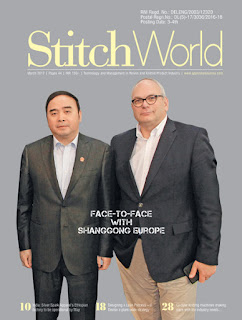
In a new series starting this issue, we will bring to our pages the leaders driving the innovation in the industry. The first part of the series is an excerpt of the discussions I had during a recent tête-à-tête with the management team of the ShangGong Group, which has acquired some really big names in European technology, including Duerkopp Adler.

During my regular visits to Bangladesh, I have noticed that the country is fast moving towards high-end technology, much more than compared to India, though India is the largest importer of sewing machines today. While India is importing a lot of basic machines, established brands are very happy working with Bangladesh for their automated machines.

It seems that the garment export industry in India has reached a plateau and now the domestic market is at the stage which was occupied by export market in the early 80s, providing good opportunities for technology providers to work in large numbers, but in basic machines. Perhaps that is why we see large number of domestic players at technology events in India these days.

I hope it is not the end of growth for the garment export industry… There has to be a lot more juice left in the industry than generally perceived. The drive to skill people in huge numbers for the sewing industry and the overtly active State Governments inviting industry to set-up units for exports with lucrative incentives, will surely not let the export industry die out.

This is one editorial in which I have not offered any solution, but only raised my concerns… If you think otherwise, please send me your views.
In the meanwhile, we bring to our readers another edition of StitchWorld which is a gamut of technology and management tools. INH Quality Management by Groz-Beckert facilitates an interconnected process for the entire history of a needle from its entry into the company through the documentation of needle breakage to the point at which it leaves the factory in a recyclable condition.

Our content remains incomplete without the experts sharing their valuable strategies and experiences. Piyush R Vyas and Anand Deshpande are there in the issue to share on how to reap the advantages from implementation of lean, not only benefiting the factory, but Indian apparel industry as a whole.